

















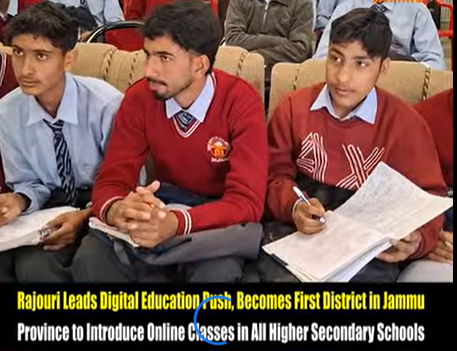
In a significant step towards promoting digital education, Rajouri has become the first district in Jammu Province to introduce online classes across all Higher Secondary Schools, aiming to improve access to quality education, particularly for students living in remote and far-flung areas.
The initiative, introduced by the Education Department, seeks to address the shortage of teaching staff in several schools by making subject-specific lessons available through virtual classrooms. Under the arrangement, subject lecturers stationed at the district headquarters have been assigned the responsibility of conducting online classes for students across the district.
The move is expected to benefit students in geographically challenging areas, including Khawas, Moghla, Lam and Ladoka, where the availability of subject specialists has often remained a concern. Through digital platforms, students in these areas can now attend lessons delivered by qualified lecturers without having to depend entirely on the limited teaching resources available within their respective schools.
The initiative marks an important step towards reducing educational disparities between urban centres and remote rural communities. By connecting schools with lecturers through technology, the district administration and Education Department aim to ensure that students receive subject-wise academic support and have better opportunities to continue their studies.
Students and school staff have welcomed the initiative, describing it as a progressive move that can strengthen the education system and help bridge existing learning gaps. The introduction of online classes is also expected to encourage greater use of digital learning tools in government educational institutions.
For students in remote parts of Rajouri, the programme offers an opportunity to access lessons that might otherwise be difficult to arrange due to shortages of subject-specific teachers. It also highlights how technology can be used to overcome geographical and infrastructural challenges in the education sector.
Rajouri’s initiative could serve as a model for other districts seeking innovative solutions to improve classroom learning and ensure equitable access to education. Its long-term success will depend on consistent internet connectivity, effective coordination between schools and lecturers, and regular monitoring of academic progress.
With this district-wide digital education initiative, Rajouri has taken a notable step towards making quality education more accessible and inclusive, particularly for students studying in underserved areas.