













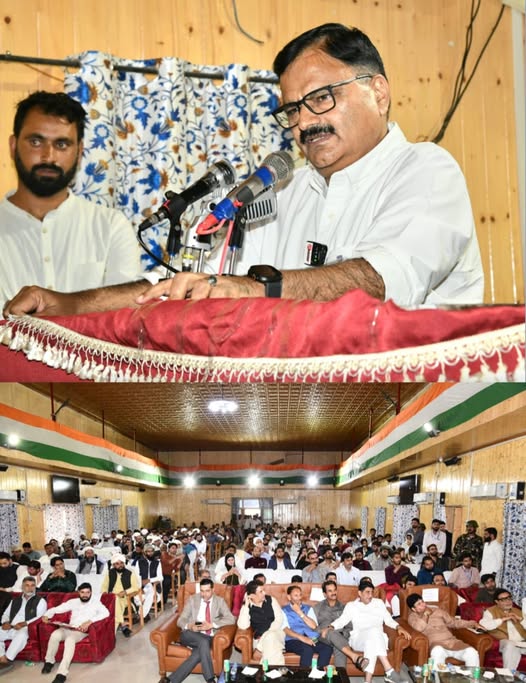
SEP 11: Tribal Affairs Minister Javed Ahmed Rana reiterated the government’s commitment to inclusive and participative planning for tribal development while addressing a Tribal Conference in Anantnag. Stressing the need for decentralised and community-driven initiatives, the Minister said that only through active involvement of tribal populations can sustainable and equitable growth be achieved.
Highlighting the core priorities of the administration, Rana emphasized healthcare, education, connectivity, and skill development as essential pillars for tribal empowerment. He said that improving access to medical services and quality education, particularly in remote tribal areas, remains central to the government’s agenda. Strengthening road and digital connectivity, he noted, is equally vital to bridge development gaps and integrate tribal communities into the mainstream.
The Minister underlined the importance of promoting traditional livelihoods, including pastoralism, crafts, and forest-based activities, which form the socio-economic backbone of tribal households. He assured that the government is working to provide institutional support to enhance productivity while preserving indigenous knowledge systems.
Rana also pointed out that conferring forest rights through Forest Rights Committees (FRCs) is a crucial step towards empowering tribal communities. By securing legal recognition of their rights, he said, the administration seeks to ensure both dignity and economic security for tribal families dependent on forest resources.
The Minister further highlighted the role of the Tribal Research Institute (TRI) in documenting, promoting, and safeguarding the diverse cultural heritage, traditions, and languages of tribal communities. He stressed that cultural preservation must go hand-in-hand with development initiatives to ensure that progress does not come at the cost of identity and heritage.
“Empowering tribal communities is at the heart of the vision of the present dispensation,” Rana said, adding that a holistic approach combining welfare, empowerment, and cultural preservation will guide all future policies and programmes. He called upon all stakeholders, including local governance institutions and civil society, to actively participate in shaping a development model that truly reflects the aspirations of tribal people.