


















NOV 29:India’s coffee heritage traces its origins to the early 1600s, when Sufi saint Baba Budan planted seven coffee seeds from Yemen in the Baba Budan Giri hills of Karnataka. What began as a small garden crop eventually evolved into a flourishing plantation sector by the 18th century. Today, India stands as a globally recognised coffee producer, known for its unique shade-grown cultivation system, ecological richness, and high-quality specialty coffees. Grown across 4.91 lakh hectares, coffee supports the livelihoods of over two million people, with smallholder farmers contributing nearly 99 percent of all holdings.
Indian coffee thrives in ecologically diverse regions—the Western Ghats, Eastern Ghats, and the North East—forming one of the world’s most biodiversity-rich cultivation belts. Plantations double as spice gardens, producing pepper, cardamom, vanilla, and fruits alongside Arabica and Robusta. India ranks as the seventh-largest coffee producer, with nearly 3.6 lakh tonnes produced annually and 70 percent exported to 128 countries.
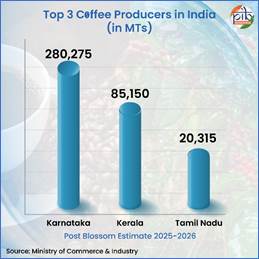
The sector’s backbone lies in three key states—Karnataka, Kerala, and Tamil Nadu—which contribute 96 percent of national production. India’s 13 agro-climatic coffee zones have earned global recognition, further strengthened by GI tags for varieties like Coorg Arabica, Wayanad Robusta, Araku Valley Arabica, and the globally admired Monsooned Malabar.
The Coffee Board of India, established under the Coffee Act of 1942, plays a central role in research, farmer support, quality enhancement, and export promotion. Through initiatives such as the Fine Cup Awards and global trade fair participation, the Board helps premium Indian coffees reach international buyers. India’s export performance has surged, crossing USD 1.8 billion in FY 2024–25, with instant coffee exports forming a major share.
Recent policy reforms—GST reduction on instant coffee, the India–UK CETA, and the India–EFTA TEPA—have created new market opportunities. At the grassroots level, tribal cooperatives like TDCCOL in Odisha are transforming livelihoods through sustainable coffee cultivation and branding initiatives like Koraput Coffee.
With rising global demand, expanding specialty markets, and a production target of 9 lakh tonnes by 2047, India’s coffee sector is poised for a new era of growth—blending tradition, innovation, and economic empowerment.