













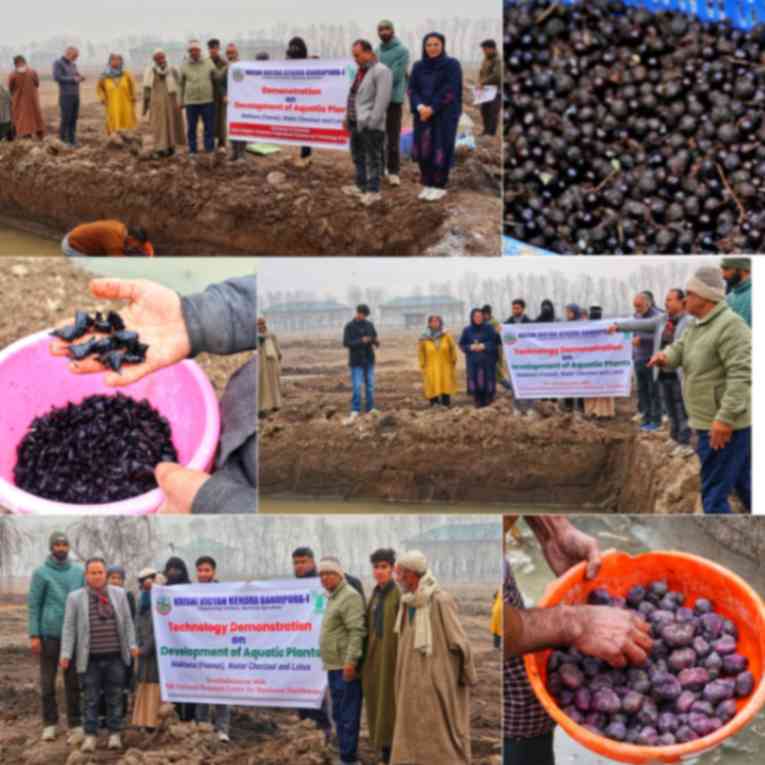
DEC 16 : In a significant step towards promoting sustainable and diversified agriculture in Kashmir, Krishi Vigyan Kendra (KVK) Bandipora-1, under the Sher-e-Kashmir University of Agricultural Sciences and Technology of Kashmir (SKUAST-K), organised a technology demonstration on scientific cultivation of aquatic crops at its demonstration farm in Bandipora.
The initiative aims to promote wetland-based agriculture, enhance farmer incomes, and ensure sustainable utilisation of water-rich ecosystems, particularly around the Wular Lake region. The demonstration focused on high-potential aquatic crops such as Gorgon Nut (Makhana/Fox Nut), Water Chestnut, and Lotus, which are well-suited to Kashmir’s wetland agro-ecological conditions.
Strategic Push for Agricultural Diversification
The programme was conducted under the guidance of Vice-Chancellor, SKUAST-K, Prof. Nazir Ahmad Ganai, who emphasised that aquatic crop cultivation can serve as a strategic intervention for diversifying farming systems and improving livelihood security for wetland-dependent communities.
Supporting the initiative, Director Extension, SKUAST-K, Prof. Raihana Habib Kanth, stressed the
importance of effective technology dissemination and farmer capacity building. She highlighted the need to integrate aquatic crops into mainstream agriculture and envisioned developing KVK Bandipora-1 as a Centre of Excellence for aquatic plant development in Jammu and Kashmir.
Strengthening Research Collaboration
The programme gained added significance in the backdrop of a Memorandum of Understanding (MoU) signed in October between SKUAST-Kashmir and ICAR–National Research Centre for Makhana (ICAR-NRCM), Darbhanga. The collaboration aims to strengthen research, technology transfer, and development of aquatic crops in the region.
Prof. Indu Shekhar Singh, Principal Scientist, ICAR-NRCM, Darbhanga, led the programme and conducted live, field-based demonstrations on scientific cultivation practices of makhana and water chestnut. He highlighted their economic viability, adaptability, and income-generating potential under Kashmir’s wetland conditions.
Focus on Post-Harvest Management and Value Addition
Emphasising the importance of profitability beyond cultivation, Prof. Syed Zameer Hussain, Professor-cum-Chief Scientist, AICRP on Post-Harvest Technology, highlighted the role of post-harvest management, processing, and value addition in enhancing returns from aquatic crops.
Meanwhile, Dr. Tariq Sultan, Senior Scientist and Head, KVK Bandipora-1, informed that lotus cultivation has already been successfully established at the KVK demonstration farm under organic conditions, achieving encouraging production levels. He noted that the success strengthens prospects for large-scale expansion of aquatic crop cultivation across the district.
Farmer Participation and Knowledge Sharing
KVK scientists Dr. Tahir Saleem and Ms. Shabnum Mumtaz provided technical inputs during interactive sessions, addressing farmer queries on crop management, pest control, and sustainable practices. Scientists, staff members, and farmers from different parts of Bandipora district actively participated in the programme.
A First for Jammu and Kashmir
The initiative marks the first organised scientific demonstration of aquatic crop cultivation in Jammu and Kashmir, representing a major step towards promoting climate-resilient, wetland-based agriculture. It also opens new avenues for livelihood generation while conserving fragile wetland ecosystems.
The programme was organised with support from Information & Public Relations, J&K, District Administration Bandipora.