



















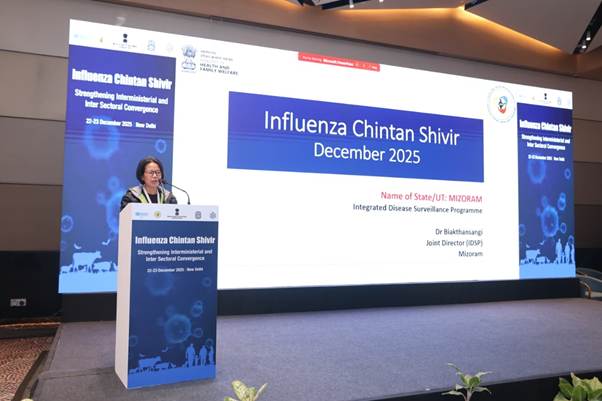
Dec 23: With the flu season approaching, the Union Ministry of Health and Family Welfare (MoHFW) has intensified India’s preparedness efforts through a two-day Influenza Chintan Shivir held in New Delhi from 22–23 December 2025. Organised by the National Centre for Disease Control (NCDC) in collaboration with World Health Organization (WHO) India, the conclave focused on strengthening inter-ministerial and inter-sectoral convergence to ensure an effective and timely response to seasonal and zoonotic influenza threats.
The Chintan Shivir brought together around 100 senior representatives from key ministries and institutions, including Health, Animal Husbandry, Agriculture, Environment, the Indian Council of Medical Research (ICMR), the Department of Animal Husbandry and Dairying (DAHD), and the National Institute of High Security Animal Diseases (NIHSAD). Eleven States with a history of influenza reporting participated in person, while officials from State and District Surveillance Units joined virtually, enabling wide-ranging cross-learning and exchange of best practices.
The inaugural session was addressed by Union Health Minister Shri Jagat Prakash Nadda through a video message. He emphasised the need for aligned preparedness and response strategies, including surge capacity planning, to enhance the country’s resilience against influenza outbreaks. Highlighting the role of the Integrated Disease Surveillance Programme (IDSP), the Minister underlined the importance of close coordination between the Centre and States to maintain a robust, real-time surveillance mechanism.
Influenza continues to pose a serious public health challenge, particularly for vulnerable groups such as young children, elderly persons, pregnant women and individuals with chronic illnesses. Recognising this risk, the deliberations stressed that preparedness cannot remain confined to the health sector alone but must involve coordinated action across human, animal and environmental health domains.
A key outcome of the two-day exercise was the development of a comprehensive and structured Influenza Preparedness Checklist, designed to guide preparedness planning at the Centre, State and District levels. The checklist covers four critical domains:
-
Surveillance, early warning and risk assessment,
-
Strengthening of laboratory systems,
-
Hospital preparedness and clinical response, and
-
One Health coordination, risk communication and community engagement.
This checklist is expected to serve as a practical tool for early detection, rapid response and effective management of influenza cases, thereby reducing morbidity and mortality during peak seasons.
The Chintan Shivir featured technical presentations, panel discussions, group work sessions and State-level presentations, allowing participants to assess existing gaps and identify actionable solutions. Discussions highlighted the importance of integrated surveillance, timely data sharing, and enhanced laboratory and genomic capacities to detect emerging strains of influenza at an early stage.
A strong consensus emerged on adopting a whole-of-Government and One Health approach, recognising the interconnectedness of human, animal and environmental health. Ministries reaffirmed their commitment to strengthening collaboration across sectors, aligning their action plans with the national pandemic preparedness framework and ensuring coordinated responses to respiratory viral threats.
The deliberations also underscored the need for effective risk communication and community engagement, especially to raise awareness about preventive measures, early reporting of symptoms and protection of high-risk populations. Officials noted that community participation plays a vital role in controlling the spread of infectious diseases.
Concluding the Chintan Shivir, participants reiterated India’s commitment to prevent, detect and respond effectively to influenza and similar public health challenges. The outcomes of the Shivir mark a significant step towards reinforcing national preparedness, ensuring that systems are in place not only for seasonal influenza but also for future pandemics.
As India continues to strengthen its public health architecture, the Influenza Chintan Shivir stands as a timely initiative, reinforcing coordinated action, scientific preparedness and inter-sectoral collaboration to safeguard public health across the country.