



















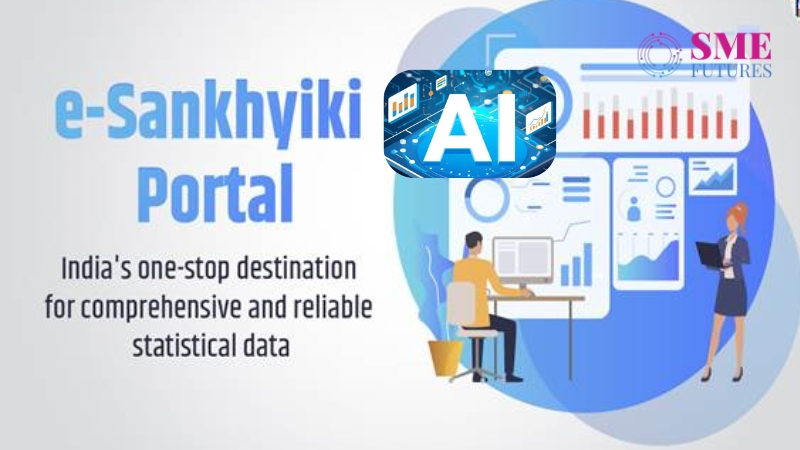
MARCH 30: In a significant move towards digital governance and smarter data management, the Ministry of Statistics and Programme Implementation (MoSPI) has integrated Artificial Intelligence (AI) into its eSankhyiki portal and launched an AI-enabled chatbot on its revamped website to improve data discovery and user interaction.
The initiative marks a major step in modernising India’s statistical ecosystem, making official data more accessible, interactive, and efficient for policymakers, researchers, and the general public.
According to the ministry, the National Sample Survey (NSS) system has undergone substantial technological upgrades in recent years. Data collection, which was earlier paper-based and time-consuming, is now conducted through advanced digital platforms such as Computer Assisted Personal Interview (CAPI) and web-based applications. These systems are equipped with in-built validation checks, ensuring data accuracy right at the point of collection.
The shift to digital platforms has significantly reduced delays in data processing. Real-time submission and validation mechanisms have streamlined workflows, enabling faster analysis and dissemination of survey results. Notably, the time taken to release NSS annual reports has been reduced from nearly eight months to approximately three months after the completion of fieldwork.
Additionally, the ministry has improved the timeliness of periodic reports. Monthly and quarterly survey reports are now released within 15 days and 40 days, respectively, from the end of the survey period—reflecting a major improvement in efficiency and responsiveness.
The integration of AI into the eSankhyiki portal is aimed at enhancing the overall user experience. With improved search capabilities and intelligent data navigation, users can now access datasets, reports, and publications more easily. The AI-powered chatbot further supports users by addressing queries, guiding navigation, and simplifying interactions with the portal.
Interestingly, chatbot-based assistance is not entirely new to MoSPI’s ecosystem. Similar features have already been introduced in select surveys such as the Annual Survey of Industries (ASI), the Annual Survey of Unincorporated Sector Enterprises (ASUSE), and the Forward-Looking Survey on Private Corporate Sector CAPEX Investment Intentions. These tools assist respondents and field officials in resolving queries during data collection, thereby improving accuracy and efficiency.
The ministry also continues to maintain transparency through its Advance Release Calendar (ARC), which provides users with tentative timelines for the release of major statistical reports. This allows stakeholders to plan and prepare for upcoming data releases.
Speaking in the Rajya Sabha, Minister of State (Independent Charge) Rao Inderjit Singh highlighted the role of AI in transforming the accessibility and usability of government data. He emphasized that while AI integration is progressing steadily, no fixed timeline has been set for its complete implementation.
Experts view this initiative as a key milestone in India’s journey towards data-driven governance. By leveraging AI and digital tools, the government is not only improving efficiency but also empowering users with faster and more reliable access to critical information.
The transition from manual to digital and now to AI-enabled systems reflects a broader shift in how public data is managed and utilised. It also aligns with India’s vision of building a robust digital infrastructure that supports informed decision-making and inclusive growth.
As AI continues to evolve, its integration into platforms like eSankhyiki is expected to further enhance the quality, accessibility, and impact of official statistics. With these advancements, India is setting new benchmarks in modern data governance—making information more transparent, timely, and user-friendly.