

















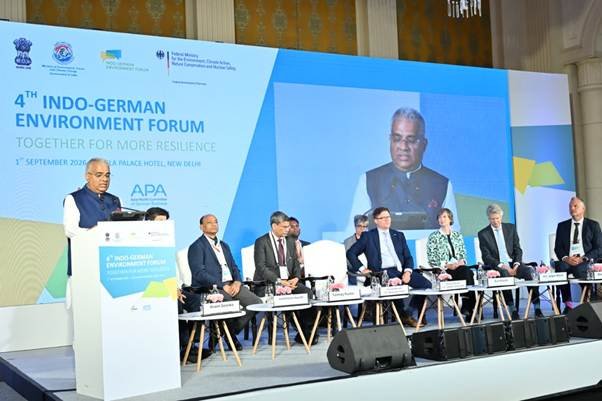
New Delhi, September 1, 2026: India and Germany have reaffirmed their commitment to deeper cooperation on climate action, biodiversity conservation, resource efficiency and sustainable development at the 4th Indo-German Environment Forum (IGEF) held in New Delhi.
Union Environment, Forest and Climate Change Minister Bhupender Yadav co-chaired the Forum with German Environment Minister Carsten Schneider, with discussions centred on building climate-resilient, resource-efficient and sustainable development pathways.
The Forum, held under the theme “Together For More Resilience,” brought together policymakers, businesses, experts, think tanks and civil society representatives to discuss practical solutions to environmental challenges.
India and Germany Seek Stronger Cooperation on Climate and Environment
Addressing the opening session, Bhupender Yadav said challenges such as climate change, biodiversity loss, pollution and resource depletion require integrated and collaborative responses.
He emphasised that environmental sustainability cannot be treated separately from economic development and highlighted India’s experience of pursuing environmental goals alongside economic growth.
According to the Minister, India has been progressing towards its commitments under its Nationally Determined Contribution (NDC) ahead of schedule, reflecting the scale of the country’s ongoing environmental transformation.
Circular Economy Could Create Major Economic Opportunities
Resource efficiency and the circular economy were among the key areas highlighted during the Forum.
Bhupender Yadav said India’s circular economy has the potential to generate a market value exceeding USD 2 trillion and create nearly 10 million jobs by 2050.
He also highlighted the establishment of the Resource Efficiency and Circular Economy Industry Coalition during India’s G20 Presidency as an important step towards placing resource efficiency and circularity higher on the global economic agenda.
The focus on circularity reflects the growing importance of reducing resource consumption, improving recycling and encouraging more sustainable production and consumption models.
Decarbonising Heavy Industries Remains a Priority
The Environment Minister also underlined the challenges involved in transitioning energy-intensive industries towards lower-carbon production.
Sectors such as steel, cement and chemicals require significant amounts of energy and resources, making their decarbonisation an important component of India’s climate strategy.
Yadav said the next phase of industrial transition would require technological innovation, cleaner energy, resource efficiency, suitable policy frameworks and new production processes.
He called for stronger international cooperation in knowledge, technology and innovation to support this transition.
Germany Praises India’s Renewable Energy Expansion
German Environment Minister Carsten Schneider highlighted India’s rapid expansion of renewable energy.
He described India’s growing deployment of solar panels and wind turbines as an example that could serve as a model for other regions.
Schneider also praised India’s momentum, progress and innovative spirit, particularly among its young population.
He said Germany and India share the objective of ensuring that sustainable development progresses alongside economic growth.
India-Germany Relations Mark 75 Years
The German Minister noted that the foundations of India-Germany relations remain strong as the two countries mark 75 years of diplomatic relations.
The longstanding partnership is increasingly expanding into areas linked to climate protection, clean technologies and sustainable development.
Both countries expressed interest in deepening cooperation and developing joint initiatives in areas where their environmental and economic priorities overlap.
Joint Declaration on Wetland Conservation Signed
A major outcome of the Forum was the signing of a Joint Declaration of Intent (JDI) on the Conservation and Wise Use of Wetlands of International Importance by Bhupender Yadav and Carsten Schneider.
The declaration is intended to provide a framework for greater cooperation on wetland conservation and management.
According to Yadav, the partnership will support efforts to strengthen scientific understanding, exchange good practices in wetland management, develop restoration approaches and increase community participation.
The initiative places wetlands within the broader framework of biodiversity protection and climate resilience.
Focus on Renewable Energy and Green Technologies
The two countries also discussed opportunities for cooperation in the green transition during the Indo-German Business Forum held on the sidelines of the event.
Bhupender Yadav highlighted potential collaboration in:
- Renewable energy
- Energy storage
- Green hydrogen
- Energy efficiency
- Sustainable manufacturing
- Clean and associated technologies
The cooperation is aimed at supporting low-carbon, resource-efficient and climate-resilient economies while also strengthening economic and industrial linkages between India and Germany.
Four Key Themes Discussed at the Forum
The 4th IGEF provided a platform for discussions across several environmental and economic themes.
Thematic sessions focused on:
- Low-Carbon Industries
- Biodiversity in Wetlands, Mountains and Forests
- Resource Efficiency and Circular Economy as a Business Model
- Sustainable Finance, Green Skills and Investment Mobilisation
The sessions brought together representatives from government ministries, businesses, expert groups, think tanks and non-governmental organisations.
Strengthening Institutional Capacity
Bhupender Yadav called for the Environment Forum to focus on three broad priorities: strengthening the knowledge and evidence base for environmental decision-making, developing practical and scalable solutions, and building stronger institutional capacity for implementation.
The emphasis reflects the need to translate environmental commitments into projects and policies that can be implemented effectively at scale.
Greater cooperation between India and Germany could facilitate the exchange of technical expertise, policy experience and innovative solutions.
Joint Working Groups Review Progress
Ahead of the main Forum, three Joint Working Groups dealing with Climate Change, Biodiversity and Circular Economy also met.
The groups reviewed progress achieved so far and discussed areas of mutual interest for future cooperation.
Their work provides a supporting mechanism for translating broader political commitments into more focused bilateral engagement.
Growing Green Economy Partnership
The latest meeting comes against the backdrop of expanding economic and industrial ties between India and Germany.
Both countries see opportunities for cooperation in sustainable technologies and the green economy, particularly as industries globally face increasing pressure to reduce emissions and improve resource efficiency.
The environment partnership therefore has the potential to support both climate objectives and economic opportunities through investment, innovation, green skills and technology collaboration.
Conclusion
The 4th Indo-German Environment Forum has strengthened the environmental partnership between India and Germany, with both countries emphasising cooperation on climate resilience, biodiversity, circular economy and clean technologies.
The signing of the Joint Declaration of Intent on the Conservation and Wise Use of Wetlands of International Importance represents a key outcome of the meeting.
With cooperation expanding into renewable energy, green hydrogen, sustainable manufacturing, energy efficiency, wetland conservation and resource efficiency, India and Germany are seeking to build a stronger foundation for sustainable economic growth.
The Forum’s emphasis on knowledge sharing, scalable solutions and institutional capacity also highlights the importance of turning environmental commitments into practical action.