



















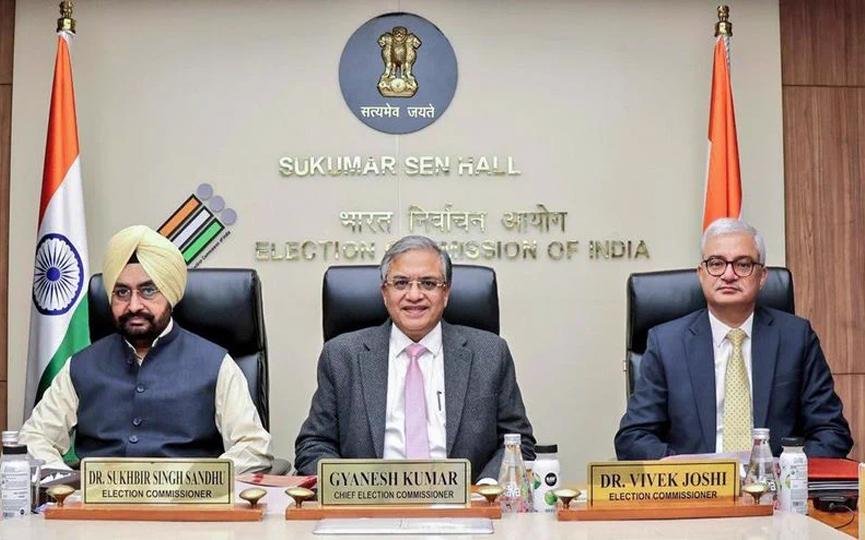
New Delhi: The Election Commission of India (ECI) has said that all institutional decisions related to the nationwide Special Intensive Revision (SIR) of electoral rolls were taken unanimously, following reports that Election Commissioners Sukhbir Singh Sandhu and Vivek Joshi had raised objections on several issues during the voter-list revision process.
The clarification came after a report by The Indian Express claimed that Sandhu and Joshi had formally objected at least 14 times over a period of 10 months to decisions and orders issued in the name of the poll panel. According to the report, four of these objections were raised on a single day.
EC Says Individual Concerns Were Part of the Deliberative Process
Responding to questions about the report, EC officials acknowledged that the two Election Commissioners had raised issues concerning voter-name deletions in different states, voter registration and the management of the electoral-roll database.
However, the Commission maintained that such observations or operational queries do not necessarily represent the final institutional decision of the three-member body. EC sources said that all decisions, including those connected with the SIR exercise, had the approval of Chief Election Commissioner Gyanesh Kumar and both Election Commissioners.
The Commission also said that differing views, suggestions and observations during the administrative process are part of institutional deliberations and are intended to improve the electoral system and safeguard voters’ rights.
Issues Raised Over Electoral Rolls and Database Management
The reported objections covered several aspects of electoral-roll administration. These included changes to statutory Form 6, which is used for voter registration, the handling of voter deletion and restoration appeals, and concerns relating to the functioning and management of the voter database.
The Indian Express report also referred to concerns over what it described as the gradual centralisation of electoral-roll database operations in Delhi and questions regarding access to the system by officials at the state level.
The ECI, however, has rejected suggestions that these exchanges represented an institutional split, reiterating that final decisions of the Commission were unanimous.
SIR Remains Under Public and Legal Scrutiny
The controversy comes as the SIR process continues to attract political and legal attention. The exercise involves verification and revision of electoral rolls, including identifying entries requiring verification and dealing with claims and objections concerning voter inclusion or deletion.
The Supreme Court has also recently examined aspects of the SIR process in Delhi, including the manner in which notices were issued to voters. On September 22, the court raised concerns about notices that appeared to have been issued without sufficient individual assessment and suggested allowing voters to respond through digital channels such as WhatsApp and email.
Opposition parties have criticised the SIR exercise and questioned the Election Commission’s approach to electoral-roll revisions, while the ECI has maintained that the exercise is aimed at ensuring accurate and reliable electoral rolls.
With the Commission now stressing that its final decisions were unanimous, the immediate issue is likely to remain focused on how individual concerns raised during internal deliberations were addressed before decisions were formally adopted.