

















India has highlighted its expanding public health infrastructure and digital healthcare initiatives at the 81st United Nations General Assembly (UNGA81), showcasing efforts in universal health coverage, hepatitis elimination and sickle cell disease care.
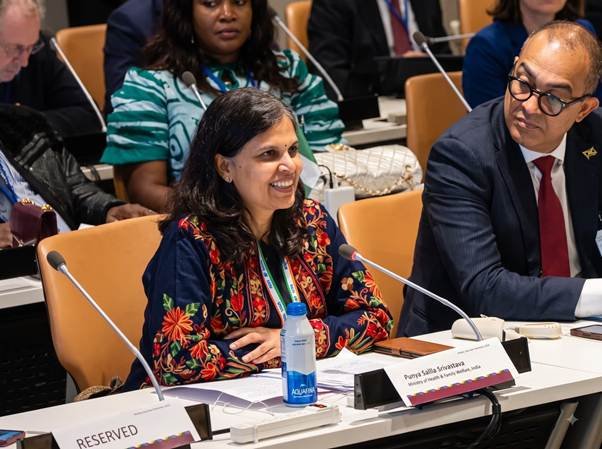
The developments were presented by Union Health Secretary Punya Salila Srivastava at key global health meetings in New York, including the Seventh Annual Ministerial Meeting of the Group of Friends of Universal Health Coverage and a side event on eliminating hepatitis. India also co-hosted the launch of OneSCD, a global partnership focused on improving sickle cell care. WHO has identified both universal health coverage and sickle cell disease as important priorities during UNGA81.
Ayushman Arogya Mandirs Expand Primary Healthcare
India highlighted its network of more than 1.8 lakh Ayushman Arogya Mandirs, which provide a range of preventive, promotive and curative healthcare services closer to communities.
The centres cover areas including reproductive and child health, screening and management of non-communicable diseases, mental health, elderly care and palliative services. The government has also stressed quality standards and stronger referral links between primary, secondary and tertiary healthcare.
The Ayushman Bharat Pradhan Mantri Jan Arogya Yojana (AB-PMJAY) was highlighted as a key component of India’s approach to financial protection for vulnerable populations. The government also pointed to free drugs and diagnostics initiatives and the National Dialysis Programme as measures aimed at reducing healthcare expenses.
Digital Health and Telemedicine Drive Access
India also showcased the expansion of its digital health ecosystem. According to the figures presented at UNGA81, more than 900 million citizens have unique health IDs, while e-Sanjeevani has facilitated more than 497 million teleconsultations.
Digital health records, interoperable registries and telemedicine services are increasingly being used to connect patients with healthcare providers, particularly in remote and underserved areas.
The broader global focus on digital innovation and resilient health systems is also reflected in WHO’s UNGA81 programme, which places universal health coverage and primary healthcare among its key priorities.
India Reaffirms Hepatitis Elimination Goal
At the UNGA81 side event on eliminating hepatitis, Srivastava reiterated India’s commitment to the 2030 target of eliminating Hepatitis B and C as public health threats.
Under the National Viral Hepatitis Control Programme, screening has been expanded across primary and tertiary healthcare facilities. The government said nearly 225 million beneficiaries have been screened since the programme was launched in 2018, while treatment services have expanded to more than 1,000 centres.
India is also integrating hepatitis prevention measures into existing maternal and child health programmes, including interventions aimed at preventing mother-to-child transmission.
OneSCD Partnership Focuses on Sickle Cell Care
India’s participation in the launch of OneSCD: A Global Partnership to Advance Equity and Transform Sickle Cell Care placed sickle cell disease at the centre of another major global health discussion.
The partnership brings together organisations and governments including WHO, UNICEF, Africa CDC, the Government of Nigeria, the World Coalition on Sickle Cell Disease and St. Jude Children’s Research Hospital.
India highlighted its National Sickle Cell Anaemia Elimination Mission, launched in 2023 with the goal of eliminating sickle cell anaemia as a public health problem by 2047.
According to the figures presented, more than 7.29 crore people have been screened, over 20 lakh carriers identified and around 2.5 lakh people diagnosed, while more than 4.93 crore Sickle Cell Cards have been distributed.
The approach combines screening, diagnosis, counselling, treatment, follow-up and digital tracking. India also highlighted efforts to improve access to point-of-care diagnostics and hydroxyurea therapy, alongside research into indigenous gene-editing approaches.
WHO has separately emphasised the need to expand equitable access to diagnosis and treatment for sickle cell disease, including wider access to hydroxyurea and child-friendly formulations.
India Positions Health as a Global Cooperation Priority
India’s interventions at UNGA81 underline a public-health approach built around primary healthcare, financial protection, digital technology and targeted disease-control programmes.
The discussions also demonstrate the growing emphasis on international cooperation in tackling diseases that continue to create unequal health outcomes. WHO’s UNGA81 agenda similarly calls for stronger health systems, universal health coverage and international collaboration.
With its focus on healthcare access, hepatitis elimination and the 2047 sickle cell target, India used the global platform to present its ongoing public health programmes while calling for greater collaboration to improve affordable and people-centred healthcare worldwide.