






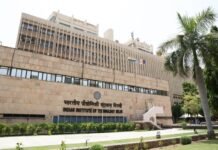









President of India Droupadi Murmu on Tuesday inaugurated the year-long Golden Jubilee celebrations of the Indian Council of Medical Research–National Institute of Malaria Research (ICMR-NIMR) in New Delhi, marking 50 years of the institute’s contributions to malaria research and public health.
The milestone event celebrated five decades of scientific research, disease prevention and efforts to strengthen India’s response to malaria and other vector-borne diseases.
As part of the celebrations, the President released a commemorative postage stamp sheet highlighting the institute’s journey. The ICMR-NIMR Coffee Table Book and a special publication titled NIMR@50: Five Decades of Science, Service and Impact were also released.
President of India+1
President Highlights India’s Progress in Malaria Control
Addressing the gathering, President Murmu highlighted India’s progress in controlling malaria over the years, noting that the disease had once been among the country’s most serious public health challenges.
She observed that improvements in healthcare services, modern diagnostic techniques, effective medicines, mosquito-control campaigns and community participation had contributed significantly to reducing the spread of malaria.
The President also noted that India’s progress towards malaria elimination had received international recognition. In 2024, India moved out of the World Health Organization’s High Burden to High Impact category.
President of India
ICMR-NIMR’s Contribution to Scientific Research
The President acknowledged the important role played by the National Institute of Malaria Research over the past five decades. Its research has covered malaria parasites, mosquito biology, vector control, insecticide resistance and community-based disease surveillance.
She also highlighted the emerging challenges posed by climate change, unplanned urbanisation and increasing mosquito resistance to insecticides, stressing the importance of environmental management and eliminating mosquito breeding sites.
Referring to other public health challenges, including dengue, tuberculosis, leprosy and kala-azar, she recognised the wider contribution of ICMR research to India’s healthcare programmes.
Research and Innovation Key to Viksit Bharat 2047
Emphasising the importance of scientific collaboration, President Murmu said research institutions, universities, technical centres and the industrial sector must work together to strengthen India’s healthcare ecosystem.
She expressed confidence that premier institutions such as ICMR and its affiliated centres would contribute to achieving the health-related objectives of Viksit Bharat 2047 through research, innovation and cooperation.
The Golden Jubilee celebrations will continue throughout the year, providing an opportunity to recognise ICMR-NIMR’s achievements while setting new priorities for scientific research and disease prevention.