

















Union Minister Dr. Jitendra Singh has reaffirmed that India’s nuclear programme is dedicated to peaceful purposes, highlighting the growing importance of nuclear energy in strengthening the country’s energy security and supporting its technology-driven economy.
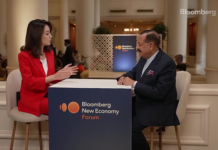
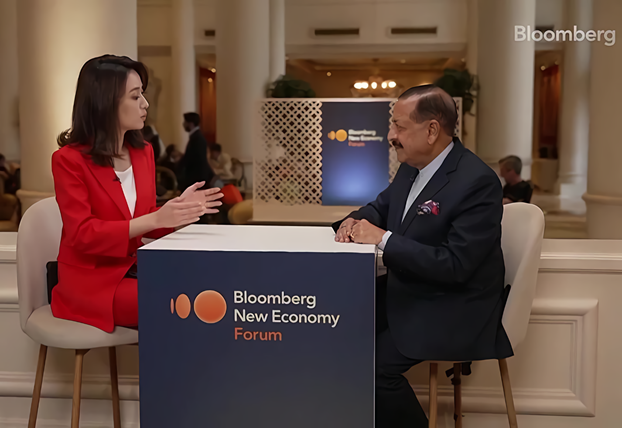
Speaking on the sidelines of the Bloomberg Economy Forum 2026, the Minister said nuclear power would become increasingly important as India prepares to meet rising electricity demand from emerging technologies, particularly Artificial Intelligence (AI) and data centres.
Recalling the vision of Dr. Homi Bhabha, the architect of India’s nuclear programme, Singh said the peaceful application of nuclear technology continues to guide the country’s approach to scientific advancement and national development.
India Targets 100 GW Nuclear Power Capacity by 2047
Dr. Jitendra Singh said India is working towards achieving 100 gigawatts (GW) of nuclear power capacity by 2047, alongside its commitment to reaching Net Zero emissions by 2070.
He highlighted nuclear energy’s potential to provide a dependable supply of electricity while complementing other sources of clean power. As India’s economy expands, ensuring a stable and reliable energy supply will be essential to supporting industrial growth, scientific research and technological innovation.
The Minister noted that the increasing adoption of AI and the expansion of data centres would significantly raise demand for uninterrupted electricity. Nuclear power, with its ability to provide continuous generation, is expected to contribute to meeting these requirements.
Responsible Use of Artificial Intelligence Is Essential
Speaking about AI, Singh emphasised that the technology should be understood as a tool that can support progress across multiple sectors, rather than as an isolated field.
He pointed to its potential applications in space, life sciences and other areas of scientific research, while stressing that human intelligence and judgement must remain central to its effective use.
“One has to be intelligent enough to use Artificial Intelligence,” the Minister said, underlining the need for responsible adoption of emerging technologies.
He also highlighted the challenge of preventing the misuse of AI, observing that regulations alone cannot guarantee responsible conduct. Integrity at both the individual and national levels, he said, is essential to ensuring that AI delivers meaningful benefits to society.
Private Sector Participation in Strategic Sectors
The Minister also highlighted the steps taken under Prime Minister Narendra Modi’s leadership to open critical and sensitive sectors to non-government participants.
According to Singh, the expanded role of private players creates opportunities for industry to contribute to innovation, technological advancement and national development. Greater participation can also help strengthen India’s capacity to respond to emerging technological and economic challenges.
The approach reflects a broader effort to encourage collaboration between the government, scientific institutions and private industry in areas that are important to the country’s long-term development.
Nuclear Energy and AI to Support India’s Development Goals
Dr. Jitendra Singh’s remarks underline the connection between reliable energy infrastructure, technological innovation and India’s development ambitions.
As the country works towards its 2047 development goals, nuclear energy is expected to play a greater role in meeting electricity demand while supporting its long-term clean energy commitments. At the same time, the responsible use of AI and wider private sector participation could help accelerate innovation across scientific and industrial fields.
The Minister reiterated the importance of maintaining India’s commitment to peaceful nuclear applications while developing the energy and technological capabilities needed for the future.