














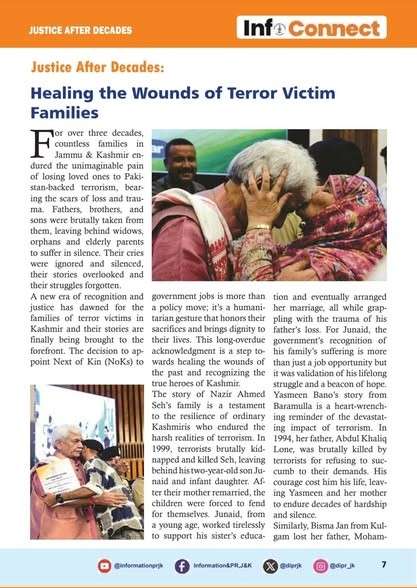
SEP 13: Justice after decades, healing begins as the Jammu and Kashmir Government has initiated a significant step to extend long-awaited support to families who bore the brunt of terrorism.
For years, thousands of families in the Union Territory have lived in silence, carrying scars of loss and displacement due to terror-related violence. Many had lost their loved ones—breadwinners, parents, or children—while others were forced into economic and social hardships with little recognition of their suffering.
In a historic move, the J&K administration has now reached out to these victims’ families, promising not just financial assistance but also measures to restore their dignity, identity, and rightful place in society. Relief packages, rehabilitation initiatives, and special welfare schemes are being rolled out to ensure that survivors are not left behind.
Officials highlighted that the move is not merely about compensation, but about recognition of the pain endured for decades. “It is about justice, about acknowledging the resilience of families who stood strong despite unimaginable hardships,” a senior officer noted.
This initiative also reflects a broader vision of healing and reconciliation in Jammu and Kashmir. Alongside economic support, the government has emphasized psychological counseling, educational opportunities for children, and livelihood assistance for affected families. By addressing both emotional and material needs, the administration aims to bring closure to long-pending grievances.
Civil society groups and community leaders have welcomed the step, calling it a much-needed gesture of empathy and humanity. They believe such measures will help build trust between people and institutions, paving the way for a more inclusive and peaceful future in the region.
For the families who have waited decades, this outreach is more than government policy—it is a symbol of hope, healing, and a chance to rebuild lives with dignity. The path to justice may have been delayed, but it is finally finding its way to those who deserve it the most.