













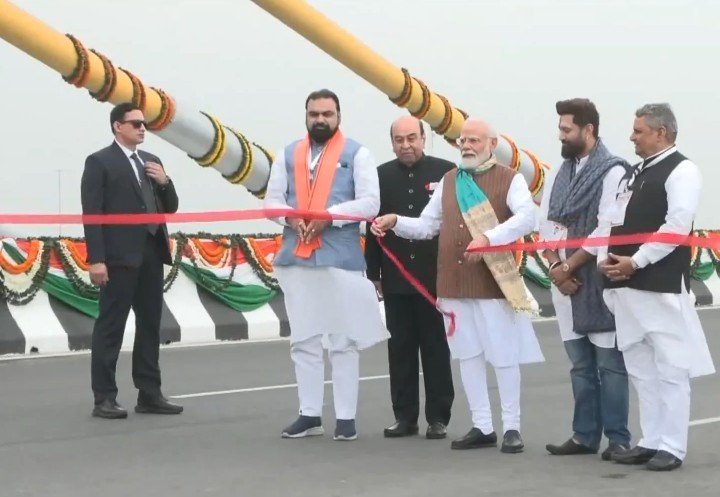
Prime Minister Narendra Modi on Saturday inaugurated and dedicated several development projects worth approximately ₹34,470 crore to the nation in Bihar’s Vaishali district, marking a major push towards infrastructure development, improved connectivity and public services across the state.
The projects cover key sectors, including road connectivity, energy, urban infrastructure, water resources, education, healthcare and public transport. The Prime Minister also laid the foundation stones for several new initiatives aimed at accelerating Bihar’s economic growth and strengthening essential infrastructure.
Nitish Setu to Improve Connectivity Across River Ganga
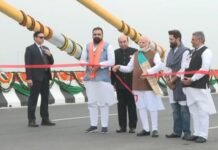
One of the major highlights of the visit was the dedication of Nitish Setu, a 19.7-kilometre-long extradosed cable-stayed bridge over the River Ganga, built at an estimated cost of ₹4,280 crore.
The bridge connects Kachhi Dargah on National Highway-22 in Patna district with Bidupur on National Highway-322 in Vaishali district. It comprises a 9.7-kilometre main bridge and 10 kilometres of approach roads.
The new bridge is expected to ease traffic congestion on the existing Mahatma Gandhi Setu and JP Setu while reducing travel time between North and South Bihar.
It will particularly benefit residents of Raghopur Diara by improving access to Patna and essential services such as healthcare and education. The improved connectivity is also expected to facilitate the transportation of agricultural produce and industrial goods, strengthening trade and commercial activities in the region.
Projects Worth Over ₹15,600 Crore Inaugurated
During the programme, the Prime Minister inaugurated several infrastructure and development projects worth more than ₹15,600 crore.
In the road infrastructure sector, major projects include the six-laning of the Aurangabad-Chordaha section of NH-19, the Chorma-Bairgania section of NH-227F and the Umagaon-Saharsa section of NH-327.
In the energy sector, the second unit of the Buxar Thermal Power Project, with a generation capacity of 660 MW, was among the important projects inaugurated. Electricity distribution and transmission infrastructure projects, including loss-reduction works worth over ₹1,130 crore under the Revamped Distribution Sector Scheme, were also included.
Other initiatives cover the restoration and strengthening of canals and embankments, a floating solar project at Phulwaria Dam in Nawada and sewerage infrastructure at Kahalgaon.
Facilities related to educational institutions, residential schools, healthcare services, agriculture, sports and public administration were also inaugurated.
Foundation Stones Laid for Projects Worth ₹14,450 Crore
The Prime Minister also laid the foundation stones for development projects estimated to cost around ₹14,450 crore.
Among the key initiatives is the four-laning of the Sahebganj-Areraj-Bettiah section of National Highway-139W, involving an investment of more than ₹3,800 crore.
The foundation stone was also laid for a power evacuation project associated with the Pirpainti Super Thermal Power Project, which has a proposed capacity of 3×800 MW and an estimated cost of around ₹3,350 crore.
Several urban water supply and sewerage projects covering cities and towns such as Begusarai, Purnea, Hajipur, Motihari, Danapur, Khagaria, Samastipur, Bodhgaya and Sitamarhi were also included.
Additional projects involve modernisation of canal systems, residential schools, the IIT Patna Research Park and hostel, engineering and polytechnic institutions, and emergency response and police data centre infrastructure.
Push for Electric Mobility and Urban Housing
As part of efforts to promote sustainable public transportation, Prime Minister Modi flagged off 100 PM-eBuses in Bihar.
The programme also marked the Griha Pravesh ceremony for more than 26,900 beneficiaries under the Pradhan Mantri Awas Yojana-Urban, highlighting the government’s continued focus on providing housing facilities to urban families.
The large-scale development programme is expected to strengthen Bihar’s infrastructure, improve public service delivery and create better opportunities for economic activities across different regions of the state.