
















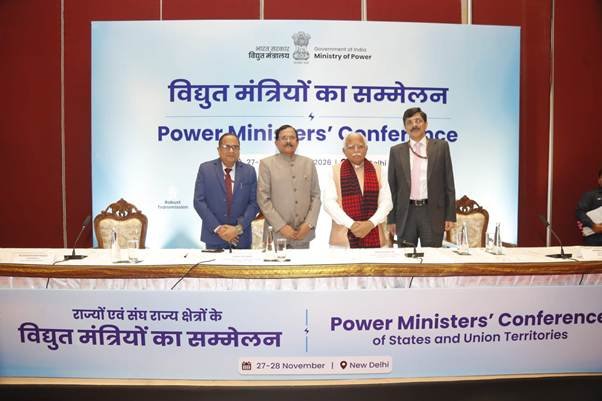
The two-day Power Ministers’ Conference, held on November 27 and 28, concluded in New Delhi with major commitments from the Centre, States and Union Territories to strengthen India’s power sector, improve electricity reliability and accelerate reforms aimed at achieving energy independence.
The conference was chaired by Union Minister for Power and Housing & Urban Affairs Manohar Lal and brought together representatives from 28 States, eight Union Territories, regulatory commissions and senior government officials under the spirit of cooperative federalism and the vision of Viksit Bharat @ 2047.
The discussions focused on resource adequacy, energy storage, transmission infrastructure, smart metering, financial sustainability of power distribution companies (DISCOMs) and improved consumer grievance redressal.
India Targets 1,297 GW Power Generation Capacity by 2035–36
During the inaugural session, the government highlighted India’s installed power generation capacity of 563 GW, with more than 55 per cent coming from non-fossil fuel sources.
The country added around 60 GW of generation capacity in the preceding year, of which 87 per cent came from non-fossil sources. The conference also outlined an ambitious target of increasing installed capacity to 1,297 GW by 2035–36.
The power sector is expected to attract investment opportunities worth approximately ₹200 lakh crore over the next two decades.
15-Fold Expansion in Energy Storage
One of the key outcomes was the commitment to expand energy storage capacity by 15 times to support round-the-clock electricity supply.
States agreed to revise their Resource Adequacy Plans up to FY 2029–30 and submit updated plans within one month. These plans will include realistic demand projections, transmission connectivity and arrangements for additional power capacity.
The conference encouraged States to accelerate battery energy storage and pumped storage projects. Upcoming NTPC and Solar Energy Corporation of India (SECI) plans, each involving 40 GWh of storage, were also highlighted.
Quarterly monitoring of capacity additions and power procurement arrangements will help track progress.
Transmission Infrastructure and Smart Metering Reforms
States also committed to strengthening transmission networks alongside generation capacity. They agreed to finalise transmission resource adequacy roadmaps, establish targets for transmission lines and substations, and promote tariff-based competitive bidding for intra-State transmission projects.
On distribution reforms, States were asked to clear pending government electricity dues within three months and shift government electricity connections to prepaid smart meters.
The conference also emphasised accelerating smart meter installations among government, commercial and industrial consumers.
To address high electricity bills and consumer complaints, utilities were advised to install check meters wherever required, review consumer mobile applications and strengthen senior-level monitoring of unresolved grievances.
Push for Agricultural Solarisation and 100 GW Nuclear Capacity
The conference also highlighted the importance of agricultural feeder segregation and solarisation to reduce electricity procurement costs and the subsidy burden on States.
On nuclear energy, States were encouraged to identify suitable locations, including retired thermal power plant sites, and ensure land and water availability for future projects.
These efforts are aligned with India’s vision of achieving 100 GW of nuclear power capacity by 2047.
Universal Household Electrification by March 2027
Another significant commitment was the completion of remaining household electrification work by March 2027, with special consideration for remote and hilly regions.
Union Power Minister Manohar Lal informed the media that approximately 14.5 lakh households had been taken up for electrification through grid and off-grid arrangements, of which around 6.25 lakh had been completed.
States agreed to accelerate the remaining work in mission mode to achieve the target.
Regulatory Reforms and Financial Sustainability
A joint session involving the Central Electricity Regulatory Commission (CERC) and State Electricity Regulatory Commissions (SERCs) discussed measures to improve the financial health of DISCOMs.
The discussions emphasised cost-reflective electricity tariffs, timely regulatory decisions and minimising tariff disallowances. Greater consultation before issuing tariff orders was also encouraged to improve transparency, reduce disputes and ensure financial predictability.
Concluding the conference, Union Minister of State for Power and New & Renewable Energy Shripad Naik said the success of the discussions would ultimately depend on the transformation delivered through their implementation.
Power Secretary Pankaj Agarwal stressed that long-term planning and timely contracting of firm power capacity would remain essential for ensuring reliable and affordable electricity.
Manohar Lal said the true success of the conference would be reflected in the lives of citizens as the Centre, States and other stakeholders work together to make the power sector a key driver of Viksit Bharat.
The conference concluded with a collective commitment to strengthen India’s electricity infrastructure, improve consumer services and build a reliable, affordable and sustainable power ecosystem.