
















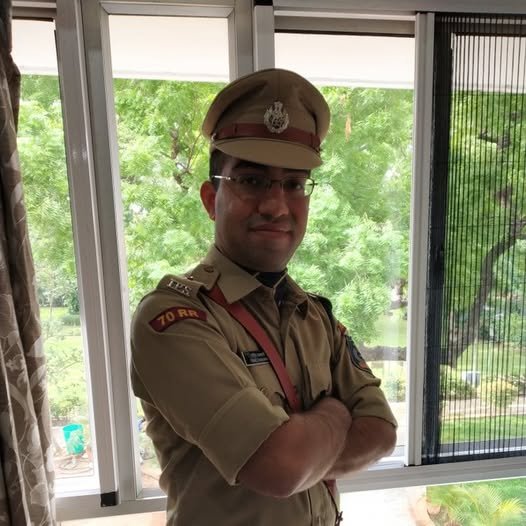
The career of Rohit Kashwani, IPS, reflects a progression through several layers of policing in Madhya Pradesh, from his early years in Jabalpur to armed police command, district-level responsibilities and, eventually, his present assignment as Superintendent of Police, Vidisha.
A 2017-batch IPS officer of the Madhya Pradesh cadre, Kashwani is originally from Rajasthan. Government records list his date of birth as November 5, 1991, his qualification as B.Tech, and his IPS identification number as 20171589. The official profile of the Sardar Vallabhbhai Patel National Police Academy (SVP NPA) also describes him as a Civil Engineer and records that he won the Martyr G. Pardesi Naidu Trophy for Indian Penal Code during his IPS probationer training.

That early recognition provides an interesting starting point to a career that has subsequently been shaped largely by field postings and operational policing.
Early Years in Jabalpur
One of Kashwani’s early important assignments was in Jabalpur, where he served as a police officer in a field role and later as Additional Superintendent of Police.
His Jabalpur posting placed him in the middle of everyday policing, where issues ranged from law-and-order management and crime prevention to coordination with the district administration.
A January 2021 report by The Hitavada provides one example of the kind of operations in which Kashwani was involved during this period.
A combined team of the Jabalpur Police, district administration and Jabalpur Municipal Corporation conducted a major anti-encroachment operation in Panagar and Adhartal. The newspaper reported that around 37,000 square feet of government land, valued at approximately Rs 30 crore, was freed from encroachments involving several properties.
The operation involved senior police and administrative officials, with Kashwani listed among the officers present at the site in his capacity as CSP, Jabalpur.
The episode is relevant to understanding his early field experience because policing at the district level often extends beyond conventional crime investigation. Maintaining security during administrative action, preventing confrontation and coordinating with other agencies are also part of the responsibilities of field officers.
Action Against Counterfeit Bidi Network
Another Jabalpur incident from 2021 brought Kashwani into the public eye in connection with an investigation involving counterfeit tobacco products.
According to The Hitavada, Kotwali Police raided a godown at Ukhri Road in June 2021 and seized 79 cartons of alleged fake Kalkatta Bidi valued at around Rs 6.50 lakh.
The report identified Kashwani, then Additional SP, Jabalpur, as the officer who briefed the newspaper about the action. Police said the raid followed a complaint alleging that counterfeit bidi products were being supplied from the premises. Three people were reported arrested, and a case was registered while further investigation was underway.
It is important to distinguish the reported police action and allegations from any eventual judicial determination. The significance of the episode for Kashwani’s career is that it illustrates the range of enforcement matters handled during his Jabalpur assignment, including commercial offences and coordinated police investigations.
A Career That Moved Through Different Forms of Policing
Kashwani’s career did not remain confined to conventional district policing.
In January 2021, Indian Masterminds reported a Madhya Pradesh government reshuffle in which Kashwani was listed as ASP, Jabalpur.
A subsequent January 2022 transfer report recorded his movement from Additional SP, Jabalpur, to the 34th Battalion SAF, Dhar, marking a transition from district field policing to command responsibilities within the Special Armed Force.
Such assignments provide different forms of professional experience. District policing requires close interaction with police stations, investigators, local communities and civil administration, while a battalion posting brings greater emphasis on force management, discipline, deployment and operational preparedness.
For an IPS officer in the early stages of a career, moving between these roles provides exposure to different dimensions of police administration.
Khargone and a Difficult Law-and-Order Period
Kashwani later took on additional responsibility in Khargone during a period of significant law-and-order tension in the district.
His role during the episode formed part of a wider policing response involving arrests, investigations, curfew arrangements and public communication. As with any reporting surrounding communal or law-and-order incidents, individual police actions and official statements need to be distinguished from subsequent legal proceedings and competing accounts of events.
The Khargone assignment nevertheless became one of the more prominent operational chapters of Kashwani’s early career, placing him in a situation where district policing required rapid decision-making and coordination among multiple agencies.
From Tikamgarh to Vidisha
Kashwani subsequently served as Superintendent of Police, Tikamgarh, taking on the responsibilities associated with leading an entire district police organisation.
The Government of India’s IPS civil list records him as SP, Tikamgarh before his transfer to Vidisha. The 2025 civil list records his appointment as SP Vidisha from October 13, 2024.
His move to Vidisha represented another step in district-level policing, with responsibility extending across crime prevention, investigations, law and order, traffic management, police administration and coordination with the district administration.
The official Vidisha district administration currently lists Rohit Kashwani as Superintendent of Police, confirming his present position.
Policing in Vidisha: Field Presence and Public Interaction
The more recent phase of Kashwani’s career has been marked by visible field engagement in Vidisha.
Local reporting has documented his inspections of police stations and night-patrolling arrangements. During one inspection, he personally reviewed night-patrol points in areas including Sarafa Bazaar, Tilak Chowk, Bajaria, Madhavganj and the railway station, while instructing personnel to remain alert and maintain surveillance over known offenders and sensitive areas.
Another recent report concerning Vidisha described inspections of police stations and directions relating to record maintenance, cybercrime prevention, e-FIR and e-Sakshya usage, as well as stronger coordination with local communities and increased beat-level interaction.
The report you shared concerning Anandapur also fits into this broader pattern of station-level engagement. The focus of the reported initiative was on interacting with people at police stations and giving directions aimed at strengthening crime control in the area.
That approach is significant because policing is increasingly dependent not only on enforcement after an offence occurs, but also on information flowing from local communities, beat officers and police stations.
A Career Beginning With Academic Recognition
There is also an important thread running through Kashwani’s career that predates his field postings.
During his IPS probationer training, the SVP National Police Academy recorded him as the winner of the Martyr G. Pardesi Naidu Trophy for Indian Penal Code. The academy’s profile identified him as a Rajasthan native, Madhya Pradesh cadre officer and Civil Engineer.
The achievement is best understood as a training-stage academic recognition rather than a national-level public award. Nevertheless, it provides a documented glimpse into his performance during the foundational phase of his police career.
From there, his professional journey moved steadily into field assignments – Jabalpur, armed police command, Khargone, Tikamgarh and now Vidisha.
Where Rohit Kashwani Stands Today
As of September 2026, Rohit Kashwani is serving as Superintendent of Police, Vidisha, Madhya Pradesh. The Vidisha district administration and Madhya Pradesh Police websites list him in that position.
His career so far covers several distinct aspects of policing: academic training, field-level law-and-order work, crime investigations, administrative enforcement operations, armed-force command and district police leadership.
That progression also puts his early career into perspective. He is a 2017-batch IPS officer who entered the service in his mid-20s and has since taken on increasingly varied responsibilities within the Madhya Pradesh Police.
A Career Still Evolving
Rohit Kashwani’s professional journey is still ongoing.
His early recognition at the National Police Academy, followed by hands-on policing in Jabalpur, a move into armed police command, additional responsibility during a difficult law-and-order period in Khargone, district leadership in Tikamgarh and his current assignment in Vidisha, shows a career built across different operational environments.
His present role as SP Vidisha brings him closer to the everyday concerns of a district — the functioning of police stations, crime control, public interaction, investigations, traffic and law-and-order management.
For that reason, the most revealing way to look at Kashwani’s career is not through a single incident or title, but through the sequence of responsibilities he has taken on since joining the IPS in 2017. His record, as documented through government records and contemporary reporting, reflects an officer whose career has progressed from probationer training and field policing to the leadership of a district police organisation.