


















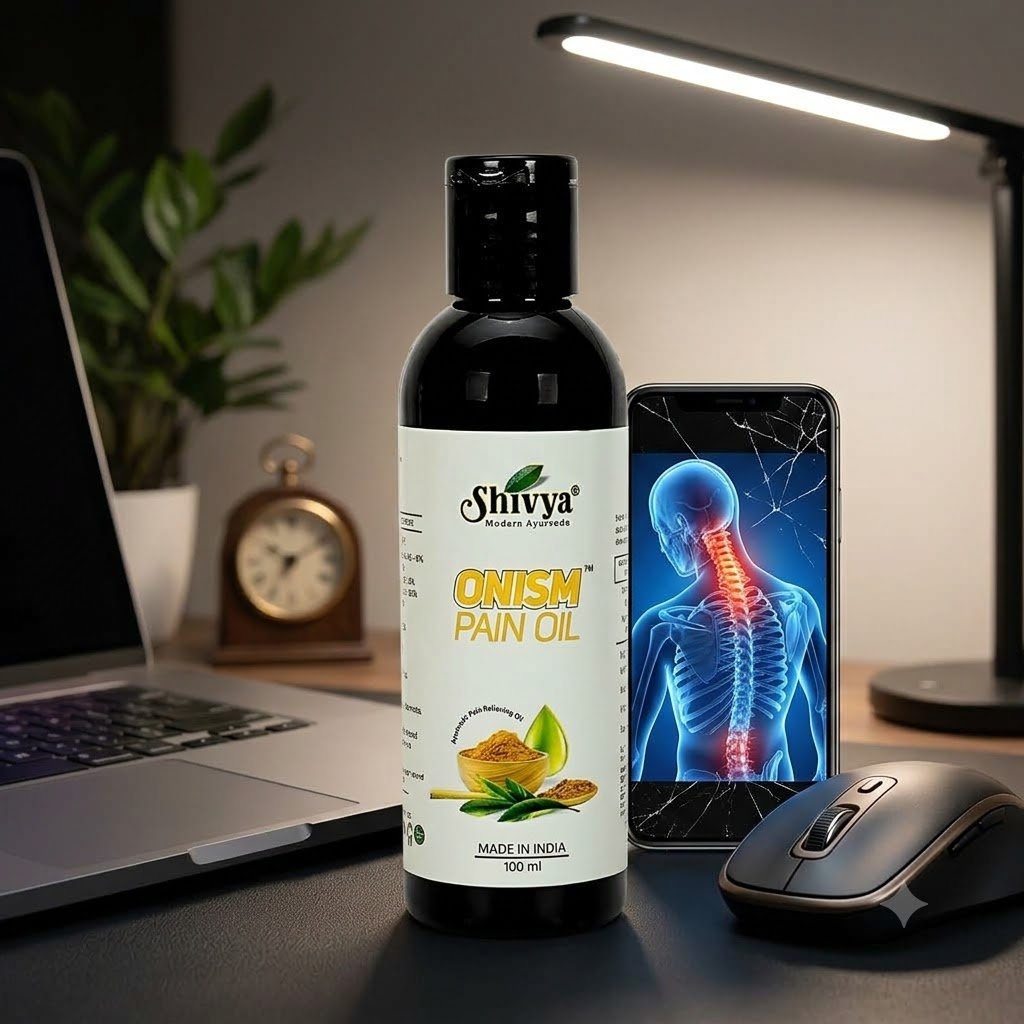
Can Shivya Onism pain relief oil be of any use for ‘Tech Neck’? What research and Ayurvedic experts have to say
If you spend hours each day working on a laptop, sitting at a desk, or looking down at your phone, neck stiffness and shoulder discomfort might be more than just tiredness. It could be what many people now call “tech neck.”
Work life has changed a lot. Meetings are now online, assignments are done on laptops and screens, and smartphones keep us connected all day. For many office workers, students, and professionals, sitting in front of a screen for hours is now normal.
But the human body was not designed to remain in one position for an entire working day.
Research on office workers consistently would point towards the importance of physical activity, strengthening, and appropriate workplace modification for people experiencing neck pain. A 2024 systematic review and meta analysis found that strengthening exercise may reduce neck pain essential and disability in office work with chronic neck pain all through the research rated the overall certainly evidence as low.
So where does an Ayurvedic pain oil such as Shivya Onism Pain Oil fit into this picture?
The answer is not that an oil can magically correct poor position. Rather, it can be considered as part of a border selfcare routine that combines better ergonomics, movement, exercise and massage.
What is “ Tech Neck”?
Tech Neck is a popular term used to describe neck and upper body discomfort associated with prolonged use of digital devices particularly when a person spends long periods with the head position forward or downward.
It is not necessary to have a formal medical diagnosis.
The underlying issue may involve service factors including.
- Remaining in one position for too long
- Forward-head positioning
- Poor workstation setup
- Prolonged laptop or smartphone use
- Reduced movement during the workday
- Muscle fatigue
- Tightness around the neck and shoulders
- Inadequate strength or endurance of supporting muscles
A systematic review examining workplace factors associated with neck symptoms in computer users found that multiple workplace and physical factors have been investigated in relation to neck pain among computer users.
In simple terms, the problem may not be the computer itself, it is often how long, how often and in what position we use it.
How Does Sitting at a Computer Affect Your Neck?
Think about a typical workday. You sit down at 9 AM. Your laptop is slightly below eye level. You lean forward to read an email. A meeting begins. You continue typing. Another meeting starts. You check your phone during lunch. Then you return to the laptop. By evening, your shoulders feel heavy and your neck feels stiff. Nothing dramatic happened. There may not have been a single injury. Instead, your muscles have simply spent hours working within a relatively restricted posture. This is why movement matters as much as posture.
Research into workplace interventions has found evidence suggesting that neck strengthening and tailored workstation modifications can help reduce neck pain among office workers, although the quality of evidence varies.
Forward-Head Posture and Neck Pain
One of the concepts frequently discussed in research on tech-related neck discomfort is forward-head posture.
This occurs when the head sits farther forward relative to the body rather than remaining comfortably aligned over the shoulders.
It can become noticeable when someone repeatedly:
- Leans toward a laptop
- Looks down at a phone
- Works with a low monitor
- Reads for long periods
- Uses a computer without adequate workstation adjustment
Importantly, posture should not be viewed too simplistically. Having a particular posture does not automatically mean that a person will develop pain.
However, research does suggest that therapeutic exercise can improve forward-head posture and may reduce pain in people with forward-head posture and neck pain.
A 2026 systematic review and meta-analysis involving 10 randomized controlled trials and 550 participants found that therapeutic exercise significantly improved measures of head and neck posture, reduced pain intensity and improved neck functional capacity. The authors also noted that the certainty of evidence ranged from low to moderate and that more research is needed.
Earlier research reached a similar broad conclusion: a systematic review and meta-analysis of seven randomized clinical trials involving 627 participants found strong evidence that exercise can modify forward-head posture and moderate evidence that it may improve neck pain.
That gives us an important lesson:
If tech neck is associated with your daily habits, correcting those habits should be part of your solution.
Can Shivya Onism Pain Oil Help with Tech Neck?
Shivya Onism Pain Oil can be incorporated into a massage and self-care routine for neck, shoulder and other muscular discomfort.
The product is positioned by Shivya for pain-management concerns including cervical pain, back pain, arthritis, sciatica, joint pain and knee pain. The product page also describes it as a fast-absorbing oil intended for application and massage over affected areas.
For someone who experiences muscular stiffness after a long day at a desk, gentle massage with an appropriate pain oil may be a reasonable component of their personal comfort routine.
But there is an important distinction:
Onism Pain Oil does not replace posture correction or exercise.
If the reason you are uncomfortable is that you spend eight hours every day leaning toward a laptop, simply applying oil without changing that routine does not address the contributing habits.
Instead, think of Onism Pain Oil as one part of a larger approach:
Ergonomics + movement + exercise + recovery + appropriate massage
That is a much more sensible approach to desk-related neck discomfort.
What Does Research Say About Massage for Neck Pain?
Massage is frequently used as a supportive approach for musculoskeletal discomfort.
Research is encouraging in some areas, but it is important not to exaggerate the evidence.
A systematic review and meta-analysis of massage therapy for neck pain found evidence of benefit in certain comparisons, while more recent systematic reviews have emphasized that the certainty and size of the benefit vary depending on the condition, treatment and comparison used.
A 2024 systematic review update included 42 randomized controlled trials involving 2,656 participants and concluded that the effects of massage for subacute and chronic neck pain varied according to what massage was compared against, with evidence ranging from very low to moderate certainty.
This is why it is more scientifically responsible to say:
Massage may support short-term comfort for some people with neck discomfort but it should not be promoted as a universal cure for neck pain.
For an Ayurvedic pain oil, the same principle applies.
The Ayurvedic Perspective: Why Massage Matters
Ayurveda has a long tradition of using external oil application and massage as part of body-care practices.
From a modern wellness perspective, massage also offers something particularly relevant to desk workers: an opportunity to slow down, relax tense muscles and become more aware of areas that have been under strain.
When combined with a suitable oil, massage can become a simple evening self-care ritual.
For people experiencing ordinary muscular stiffness after prolonged sitting, this may be especially appealing because it does not require complicated equipment.
However, Ayurvedic self-care should not be used to delay medical assessment when symptoms are severe, persistent or associated with neurological warning signs.
How to Use Onism Pain Oil as Part of a Desk-Worker Routine
According to the product information, Onism Pain Oil can be applied to the affected area and massaged, with use stated as two or three times daily or as advised by a health expert.
For desk-related muscular discomfort, a simple routine could look like this:
- Finish your screen session
Step away from the laptop rather than immediately switching from one screen to another.
- Relax your shoulders
Let your shoulders drop naturally instead of holding them raised or tense.
- Apply the oil as directed
Use Onism Pain Oil according to its label directions.
- Massage gently
Massage the affected muscular area without using excessive pressure. Add gentle movement, Follow the massage with comfortable neck and shoulder movements.
- Change the workstation tomorrow
The most important step is not to repeat the same setup that caused the discomfort.
7 Ways to Prevent Tech Neck While Working
- Bring the screen closer to eye level
A low laptop can encourage you to bend your neck downward for extended periods.
A laptop stand or external monitor can help create a more comfortable viewing position.
2. Don’t stay frozen in one position
There is no magical posture that makes sitting for eight hours harmless.
- Change positions regularly.
- Stand up.
- Walk.
- Stretch.
- Move your shoulders.
3. Strengthen your neck and upper-body muscles
Research supports strengthening as a potentially useful strategy for office workers with neck pain. A 2024 systematic review found significant reductions in pain and disability in several studies involving strengthening exercises, although the certainty of evidence was low.
4. Give your eyes and body a break
Use breaks as an opportunity to move rather than simply changing from your laptop to your phone.
5. Keep your shoulders relaxed
Avoid continuously lifting or rounding the shoulders while typing.
6. Support your back
A comfortable workstation can reduce the need to lean toward the screen.
7. Don’t ignore recurring pain
If discomfort keeps returning despite improving your routine, it may be time to speak with a healthcare professional.
A Simple 5-Minute “Tech Neck” Reset
If you have been sitting for several hours, try this simple routine:
Minute 1: Stand up and walk around.
Minute 2: Slowly roll your shoulders backward and forward.
Minute 3: Gently rotate your neck from side to side within a comfortable range.
Minute 4: Perform gentle chin-retraction movements without forcing your neck.
Minute 5: Take a few deep breaths, relax your shoulders and return to work with your screen positioned comfortably.
The idea is not to perform an intense workout at your desk.
It is simply to break up prolonged inactivity.
Interestingly, a 2026 systematic review and meta-analysis of micro-exercise interventions in sedentary workers found that brief exercise interventions were associated with reductions in neck and shoulder pain, although the authors highlighted substantial heterogeneity and varying certainty across outcomes.
Is Tech Neck Only a Problem for Office Workers?
Not at all.
Today, tech-related neck strain can affect:
- IT professionals
- Students
- Graphic designers
- Video editors
- Digital marketers
- Gamers
- Content creators
- Accountants
- Online teachers
- Freelancers
- Remote workers
- Smartphone-heavy users
In other words, anyone who spends long periods in a relatively fixed position around digital devices can develop neck or shoulder discomfort.
That is why this is becoming a lifestyle issue rather than simply an “office problem.”
When Should You See a Doctor?
Do not assume every neck problem is tech neck.
Seek professional medical advice if you experience:
- Severe or worsening pain
- Pain following an accident or injury
- Numbness or tingling
- Weakness in an arm or hand
- Pain travelling down an arm
- Significant loss of movement
- Persistent symptoms despite self-care
- Severe headache with other concerning symptoms
- Fever or other unusual symptoms
These signs can indicate something beyond ordinary muscular stiffness.
An oil or massage should not be used as a substitute for diagnosis when medical evaluation is appropriate.
Can Onism Pain Oil “Fix” Tech Neck?
Not on its own, and that is an important distinction. Tech neck is often connected with prolonged screen exposure, sustained positioning, inadequate movement and other lifestyle or workplace factors. The research increasingly supports a broader approach involving exercise, strengthening, movement and appropriate workplace modifications. Massage may provide additional comfort for some people, although the evidence varies according to the type of neck pain and treatment used. That makes Shivya Onism Pain Oil best positioned as a supportive part of a daily pain-management and self-care routine, rather than as a standalone cure.
The Bottom Line
Your laptop isn’t going away. Neither is your smartphone. But your working habits can change.
If you spend hours at a desk, start by making your workstation more comfortable. Move regularly. Strengthen the muscles supporting your neck and shoulders. Take short activity breaks. Avoid spending the entire day in one position. And when everyday muscular stiffness or discomfort occurs, Shivya Onism Pain Oil can be incorporated into your massage and self-care routine. The goal isn’t simply to find an oil for neck pain. The goal is to build a healthier relationship with the technology you use every day. Work smarter. Move more. Sit consciously. Give your neck a break.
Frequently Asked Questions
- What is tech neck?
Tech neck is a popular term for neck and shoulder discomfort associated with prolonged use of smartphones, computers and other digital devices, particularly when the head remains forward or downward for extended periods.
- Can sitting at a computer cause neck pain?
Prolonged computer use can be associated with neck pain, particularly when combined with sustained positioning, limited movement and unfavorable workplace factors. Research on computer users and office workers supports addressing both physical activity and workplace factors.
- Can Onism Pain Oil help with neck stiffness?
Shivya Onism Pain Oil is positioned for cervical, joint, back and other pain-management concerns and can be used for massage according to the product directions. It may be incorporated into a self-care routine for muscular discomfort and stiffness.
- Does massage help neck pain?
Research suggests massage can provide benefit in some people with neck pain, but the size and certainty of benefit vary. Recent systematic reviews have highlighted limitations in the available evidence.
- What is the best exercise for tech neck?
There is no single exercise that is best for everyone. Research supports therapeutic exercise, including strengthening and combined approaches, for improving forward-head posture and reducing neck pain in appropriate populations.
- How can I prevent tech neck?
Improve your workstation setup, avoid staying in one position for prolonged periods, take regular movement breaks, perform appropriate exercises and pay attention to how you use your laptop and phone.
- When is neck pain more serious?
Neck pain accompanied by weakness, numbness, tingling, significant arm symptoms, severe headache, trauma or other concerning symptoms should be medically assessed rather than assumed to be tech neck.