



















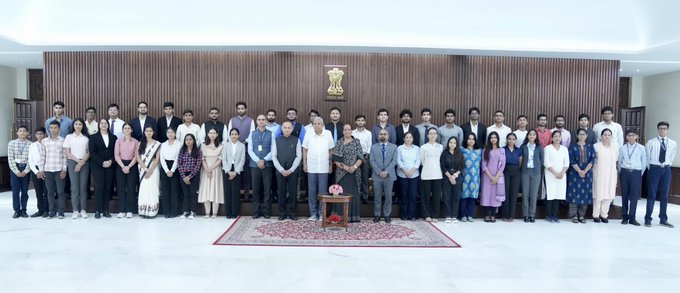
MAY 27: Speaking at the inauguration of the 7th phase of the Rajya Sabha Internship Programme, Vice-President and Rajya Sabha Chairman Shri Jagdeep Dhankhar delivered a compelling address highlighting the significance of national security, constitutional responsibility, and economic self-reliance.
Stressing the importance of indigenous capability, the Vice-President stated, “Peace is secured when you are ever ready for war. Strength comes not only from technological and military capabilities but also from the will and unity of the people.” He emphasized that national security is best safeguarded through self-reliance and constant preparedness.
Calling attention to fundamental duties, he noted that citizens must strike a balance between their rights and responsibilities. “We claim our rights 24×7 but often neglect our duties. The 11 fundamental duties, added through the 42nd and 86th Amendments, were introduced to instill civic consciousness and prioritise national well-being,” he said. Duties, he added, include contributing to public order, discipline, the environment, and national development.
He further connected economic nationalism to everyday consumer choices, advocating for the consumption of Swadeshi products. “Economic nationalism is the business of the people. When we import what can be made in India, we hurt our economy, deprive our citizens of employment, and blunt our entrepreneurial spirit.”
Reflecting on recent events such as Operation Sindoor, the Vice-President said the nation is now more unified and nationalistic than ever. He urged all political stakeholders to put national interest above partisan agendas on issues such as internal security and economic development. “All institutions must work with the shared goal of national growth, transparency, and public welfare.”
Dhankhar also celebrated the deep cultural roots embedded in India’s Constitution. Highlighting the 22 miniatures included in the original manuscript, he explained how they depict the country’s civilizational richness—from Gurukuls and the Indus Valley to Lord Ram’s return to Ayodhya and Lord Krishna’s discourse in Kurukshetra.
He concluded by urging young interns to respect constitutional boundaries and uphold democratic ideals. “India is one of the few countries where fundamental rights can be enforced by approaching the highest court. But with such rights comes a responsibility to protect the sanctity of constitutional domains—both within our borders and in our conduct.”
This call for unity, responsibility, and indigenous pride marked a powerful message for India’s youth and polity alike.