















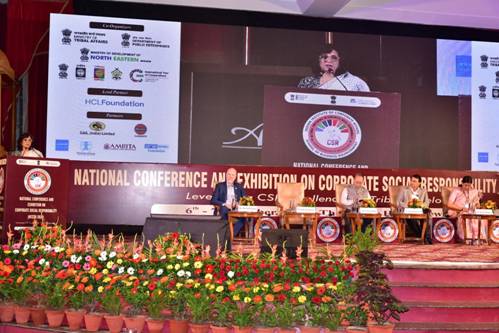
OCT 09:The Indian Institute of Corporate Affairs (IICA), under the Ministry of Corporate Affairs, Government of India, concluded its National Conference & Exhibition on ‘Leveraging CSR Excellence for Tribal Development’ on 7th October 2025 in New Delhi. The event marked the 2nd Annual IICA CSR Day, highlighting inclusive, collaborative, and sustainable growth through community-centric CSR initiatives.
The two-day conference brought together over 400 delegates from government, industry, academia, and civil society to deliberate on aligning Corporate Social Responsibility (CSR) strategies with national priorities for tribal welfare and sustainable livelihoods. Cultural performances during the valedictory session celebrated India’s tribal heritage, symbolizing the integration of indigenous traditions into modern development frameworks.
Shri K. Moses Chalai, Secretary, Department of Public Enterprises, emphasized the importance of long-term CSR initiatives in skill development, entrepreneurship, and digital inclusion to enable self-reliant tribal communities. He urged Central Public Sector Enterprises (CPSEs) to set clear objectives, measurable targets, and defined milestones to ensure tangible social and environmental impact. He also highlighted the need for collaborative efforts between corporates, state governments, and civil society for effective implementation.
Smt. Deepti Gaur Mukerjee, Secretary, Ministry of Corporate Affairs, commended IICA for fostering a platform that unites policymakers, corporate leaders, and community practitioners. She proposed a revamped CSR Exchange digital platform to facilitate project mapping, collaboration, and knowledge sharing. She stressed community participation and culturally sensitive approaches as central to the sustainability of CSR projects.
Shri Gyaneshwar Kumar Singh, DG & CEO, IICA, highlighted that CSR should go beyond financial contributions to focus on technological, managerial, and outcome-driven interventions. He called for geographically balanced funding, capacity building, and integration of AI and analytics for monitoring and impact assessment. He emphasized that research, innovation, and private sector engagement are essential to achieving Viksit Bharat 2047.
The conference concluded with an emphasis on CSR as a strategic tool for tribal empowerment, leveraging innovation, data-driven planning, and multi-stakeholder collaboration to drive long-term social, economic, and environmental benefits.

, under the Ministry of Corporate Affairs, Government of India, concluded its National)