


















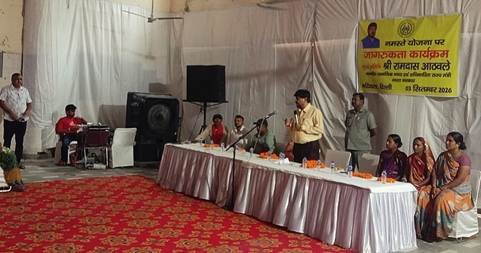
New Delhi, September 4, 2026: Union Minister of State for Social Justice and Empowerment Ramdas Athawale inaugurated the distribution of NAMASTE Cards to waste pickers from the Municipal Corporation of Delhi’s (MCD) Najafgarh Zone at an event held at the MCD Community Hall in Matiala.
The programme marked an important step towards the formal recognition, welfare and empowerment of waste pickers, who play a vital role in maintaining cleanliness and supporting sanitation systems in urban areas.
Ayushman Cards Also Distributed
Alongside NAMASTE Cards, Ayushman Cards were also distributed among participating waste pickers, extending healthcare-related benefits to members of the workforce.
More than 300 waste pickers from the Najafgarh Zone took part in the programme.
Addressing the gathering, Athawale appreciated the contribution of waste pickers to keeping cities clean and highlighted their importance to public sanitation and community health.
The Minister assured workers of the government’s continued cooperation and support, particularly in improving their working conditions and helping them access various welfare schemes.
NAMASTE Scheme Focuses on Safety and Dignity
The National Action for Mechanised Sanitation Ecosystem (NAMASTE) is a Central Sector Scheme of the Ministry of Social Justice and Empowerment.
The programme seeks to improve the safety, dignity and socio-economic well-being of sanitation workers, including sewer and septic tank workers as well as waste pickers.
A key objective is to move away from hazardous manual sanitation practices by promoting mechanisation and safer working methods.
Wider Access to Welfare Benefits
The scheme also focuses on formal identification of sanitation workers, occupational safety, healthcare and social security, skill development and improved livelihood opportunities.
The distribution of NAMASTE Cards provides workers with formal recognition while helping connect them with welfare and support mechanisms.
The addition of Ayushman Cards at the Delhi programme further underlined the importance of linking sanitation workers with healthcare coverage.
Recognising an Essential Urban Workforce
Waste pickers often work at the grassroots level of the urban waste-management system, contributing to cleaner neighbourhoods and improved waste recovery.
The Najafgarh event highlighted the government’s focus on ensuring that this contribution is accompanied by greater access to social security, healthcare, safer working conditions and dignity at work.
The initiative reflects a broader effort to strengthen sanitation systems while ensuring that workers associated with them are not left outside the formal welfare framework.