






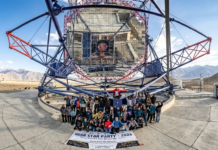











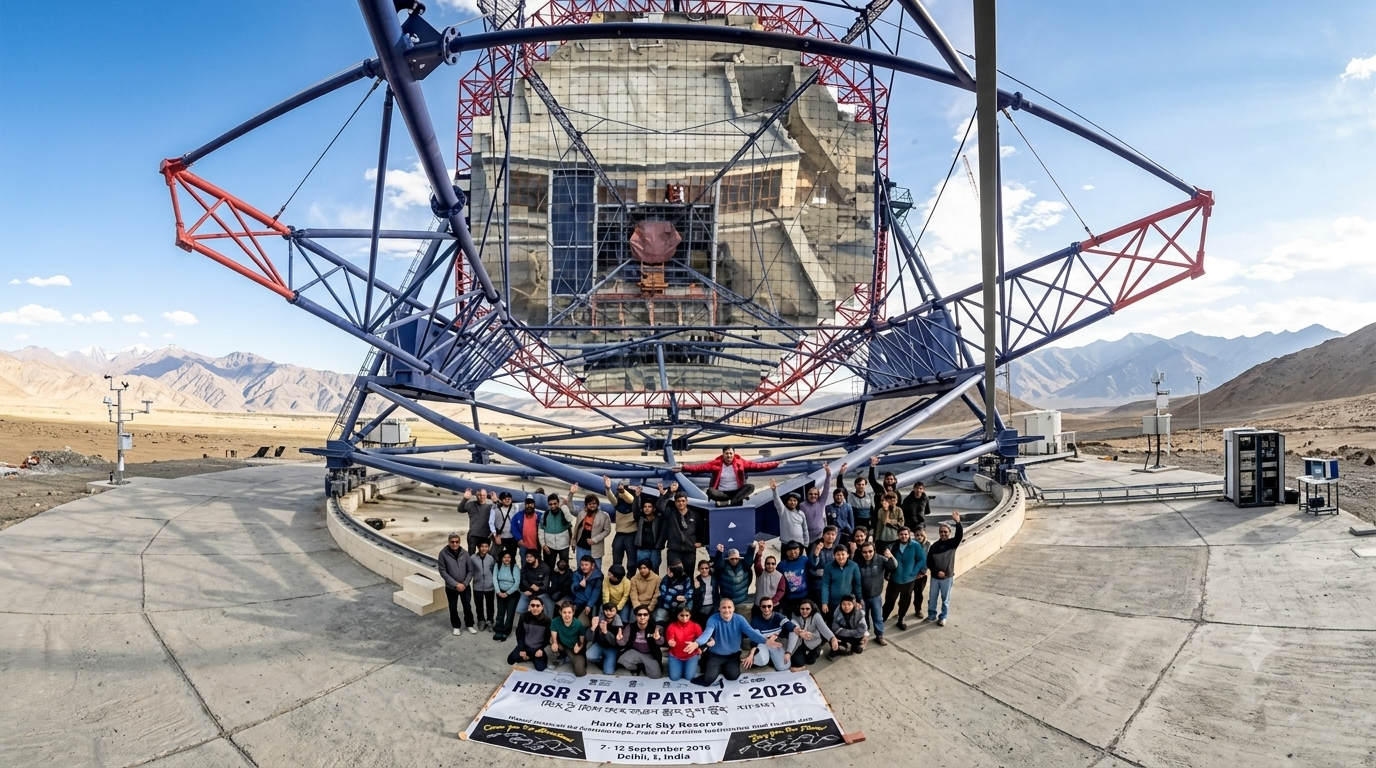
Hanle, Ladakh, September 15, 2026: The fourth edition of the Hanle Dark Sky Reserve (HDSR) Star Party brought together astronomy enthusiasts, astrophotographers and experts from across India for six days of night-sky observation, astrophotography and public outreach in Ladakh.
Held from September 7 to 12 at the Indian Astronomical Observatory in Hanle, the event saw around 40 amateur astronomers from Chandigarh, Goa, Gujarat, Haryana, Himachal Pradesh, Karnataka, Maharashtra, New Delhi, Madhya Pradesh, Tamil Nadu, Rajasthan and Uttar Pradesh participate.
The participants travelled to Leh with advanced astronomical equipment and spent four nights observing and photographing celestial objects under Hanle’s exceptionally dark skies.
Promoting astronomy and protecting dark skies
The Star Party was jointly organised by the Indian Institute of Astrophysics (IIA), Department of Wildlife Protection of the UT Ladakh administration, Bhabha Atomic Research Centre (BARC) and Tata Institute of Fundamental Research (TIFR).
IIA Director Prof Annapurni Subramaniam said the strong participation of amateur astronomers and astrophotographers demonstrated the importance of preserving Hanle’s pristine night skies for both scientific research and public engagement.
A major attraction of the programme was the Open Night held on September 10, which attracted more than 1,200 local residents and tourists.
Visitors were given opportunities to observe the night sky through specially designated amateur telescopes. Star Party participants, HDSR Astronomy Ambassadors and observatory personnel guided visitors and explained various astronomical phenomena.
Regional officials were also invited to observe through the telescopes and were briefed about the importance of controlling artificial light and reducing light pollution in the region.
Local villagers trained as astronomy ambassadors
The event also strengthened the connection between astronomy and local communities.
Training sessions were organised every evening for 25 HDSR Astronomy Ambassadors, comprising local villagers who have received astronomy training over the past three years. These ambassadors conduct astronomy tours for visitors and have been provided telescopes by the Ladakh administration.
Experienced participants at the Star Party mentored the ambassadors in practical aspects of night-sky observation and astrophotography, helping enhance their ability to offer astronomy-based experiences to tourists.
The initiative demonstrates how scientific interest and responsible tourism can create new opportunities for local communities while supporting conservation of the night sky.
Hanle emerges as a major astro-tourism destination
The Hanle Dark Sky Reserve, notified by the Ladakh administration in December 2022, is recognised for its exceptionally dark and clear skies, making the region particularly suitable for astronomical observations and astrophotography.
The reserve forms part of an astronomy-based socio-economic development initiative that seeks to reduce light pollution, facilitate scientific research and promote astro-tourism while generating economic benefits for communities in the region.
The initiative is supported by multiple stakeholders and anchored by the Indian Astronomical Observatory at Hanle, operated by the Indian Institute of Astrophysics, an autonomous institution under the Department of Science and Technology.
Need to protect Hanle’s skies amid expansion
The annual Star Party also drew attention to the need to safeguard Hanle’s unique observing conditions as new astronomical infrastructure is planned in the region.
Prof D.K. Sahu of IIA, Scientist-in-Charge of the Observatory, emphasised that protecting Hanle’s dark skies will become increasingly important with the proposed installation of major astronomical facilities, including the 3.7-m upgraded Himalayan Chandra Telescope and the 13.7-m National Large Optical-infrared Telescope.
The Star Party thus served not only as an opportunity for astronomy enthusiasts to explore the cosmos but also as a reminder that preserving dark skies is essential for scientific research, education, tourism and the long-term development of Hanle as an international astronomy destination