


















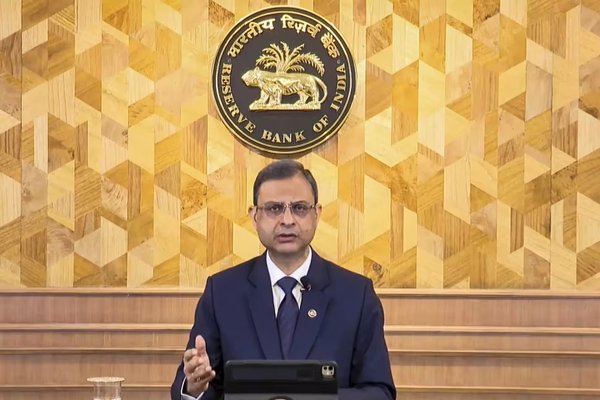
The Reserve Bank of India (RBI) on Wednesday raised the benchmark repo rate by 25 basis points to 5.5 per cent, marking the first increase in the policy rate since February 2023. The decision was taken by the six-member Monetary Policy Committee (MPC) amid renewed inflationary pressures and continued global economic uncertainty. Akashvani News
RBI Governor Sanjay Malhotra announced the decision following the MPC’s three-day meeting. The rate hike represents a shift in the central bank’s recent policy direction after a series of rate cuts in 2025 and a prolonged period of holding the repo rate at 5.25 per cent. Rediff
Policy Stance Shifted to ‘Calibrated Tightening’
Along with the rate hike, the MPC changed its monetary policy stance from ‘neutral’ to ‘calibrated tightening’. While all members supported the 25-basis-point increase in the repo rate, four members backed the change in stance, while two preferred to retain the neutral position. Akashvani News
The change signals that the RBI is placing greater emphasis on controlling inflation while retaining flexibility to respond to evolving economic conditions.
Inflation Outlook Revised Higher
Inflation has emerged as a key factor behind the RBI’s latest decision. Retail inflation increased to 4.82 per cent in August, up from 4.45 per cent in July. The central bank has now raised its inflation projection for the financial year to 5.2 per cent, compared with its earlier estimate of 5.1 per cent. Akashvani News
The RBI has projected inflation at 4.9 per cent in the second quarter, 6 per cent in the third quarter and 5.7 per cent in the fourth quarter. Rising food and energy prices, along with international developments, remain important risks to the inflation outlook. Business Standard
Growth Outlook Remains Strong
Despite inflationary challenges and global uncertainty, the RBI maintained a positive assessment of India’s economic growth prospects. It raised its FY27 real GDP growth forecast to 7.1 per cent, with quarterly growth projected at 7.2 per cent in Q2, 6.9 per cent in Q3 and 6.8 per cent in Q4. Akashvani News
The central bank noted that domestic economic activity continues to receive support from consumption, investment, manufacturing and services.
What the Rate Hike Means for Borrowers
The increase in the repo rate could put upward pressure on borrowing costs, particularly for loans linked to external benchmarks. Home, vehicle and corporate borrowers could see higher interest costs, while existing borrowers may face increased EMIs depending on their loan structure and lenders’ transmission of the policy change. Rediff
The RBI’s next MPC meeting is scheduled for December 2–4, 2026, when policymakers will reassess inflation, growth and global economic developments before deciding the next policy course. Rediff