















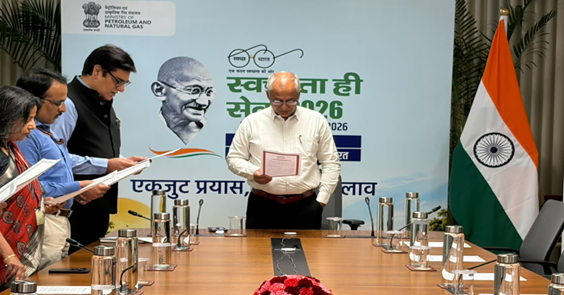
New Delhi, October 19: The Ministry of Petroleum and Natural Gas has successfully completed the Swachhata Hi Seva 2026 campaign, recording significant progress in cleanliness drives, public-space improvement, sanitation worker welfare and sustainable waste management across the country.
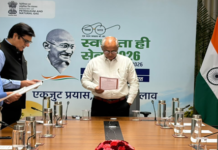
Conducted from September 17 to October 2, 2026, the campaign involved the Ministry’s attached offices and Central Public Sector Enterprises (CPSEs) under its administrative control. The initiative began with a pledge-taking ceremony administered by the Secretary of the Ministry at Kartavya Bhawan-3, New Delhi, on September 17.
During the campaign, the Secretary regularly reviewed progress and directed participating organisations to expand public involvement and intensify cleanliness activities.
Nearly 10,000 Cleanliness Units Transformed
One of the campaign’s major achievements was the transformation of 9,845 Cleanliness Target Units (CTUs), with 99,548 people participating in these efforts. Additionally, 937 public spaces were cleaned with the involvement of 45,526 participants.
The campaign also recorded 543 mohalla cleanliness drives and 143 cleanliness initiatives at water bodies, involving 1,264 participants. These activities aimed to improve local surroundings, encourage community participation and promote the protection of water resources.
Students Mobilised Through Swachh Pathshala
The Swachh Pathshala: Yuva for Swachhta initiative focused on engaging students, educational institutions and communities in cleanliness and environmental awareness programmes.
A total of 18,700 schoolchildren participated in the reported activities, which included school-level cleanliness initiatives, awareness demonstrations, Jal Sanchay Samvad and Gyan Yatra programmes. Gyan Yatra activities alone recorded 3,109 student participants.
The initiative sought to encourage young people to adopt responsible environmental practices and carry the message of cleanliness into their homes and communities.
Focus on Sanitation Workers’ Health and Safety
Recognising the contribution of sanitation workers, the Ministry’s organisations organised 234 Safai Mitra Suraksha Evam Samman Shivir, recording the participation of 7,098 sanitation workers.
The campaign also reported 276 preventive health check-ups involving 4,365 participants and the distribution of 3,518 personal protective equipment (PPE) kits.
These measures highlighted the importance of workplace safety, preventive healthcare and dignity for sanitation workers.
Community Participation and Plastic Reduction
Under the Jan Bhagidari for Swachhta initiative, citizens were encouraged to participate in composting awareness programmes, plastic-reduction campaigns and community events.
The campaign recorded 450 composting awareness drives and 154 Sports for Swachhta activities involving 3,530 participants. The Say No to Plastics initiative engaged 2,662 participants, promoting awareness about reducing plastic use and adopting more sustainable waste-management practices.
Promoting Waste Recycling and the Circular Economy
The Swachhata Se Samriddhi pillar focused on waste-to-wealth initiatives and creative reuse through programmes such as Kabaad Se Jugaad and Kabaad Se Kala.
Reported achievements included engagement with 191 art colleges and institutions, 175 plastic recycling melas and assessments of 135 Plastic Waste Management Units. The campaign also recorded 687 entries under Kabaad Se Jugaad and 607 entries under Kabaad Se Kala.
These activities encouraged innovation in waste reuse, recycling and resource recovery, supporting broader efforts to strengthen the circular economy.
Sustaining Cleanliness Beyond the Campaign
The Ministry stated that the achievements reflected the collective participation of its organisations, employees, students, sanitation workers and citizens.
Through cleanliness drives, awareness programmes, welfare camps and waste-management initiatives, Swachhata Hi Seva 2026 sought to promote cleanliness as a continuing public responsibility rather than a time-bound activity.
The Ministry of Petroleum and Natural Gas reaffirmed its commitment to environmental responsibility, community participation and sustained cleanliness efforts, contributing to the broader vision of a clean and developed India.