



















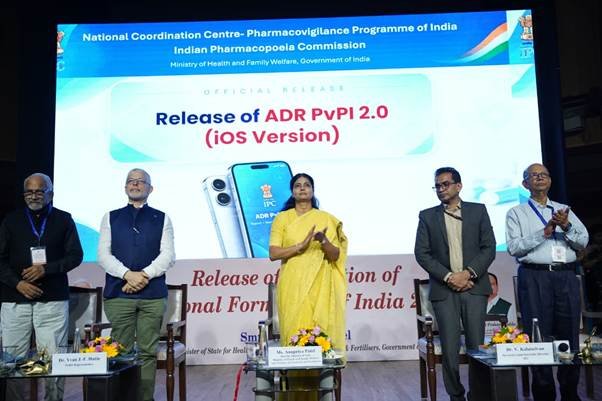
New Delhi: India has taken another step towards strengthening medicine safety and patient protection with the launch of the 7th Edition of the National Formulary of India (NFI) 2026 and the announcement of the Biovigilance Programme of India.
Union Minister of State for Health & Family Welfare and Chemicals & Fertilizers Smt. Anupriya Patel launched the initiatives on September 21 during the 6th National Pharmacovigilance Week programme organised by the Indian Pharmacopoeia Commission (IPC) at Dr. Ambedkar International Centre in New Delhi.
The Minister also unveiled the Guidance Document for Hospitals in India for Safety Monitoring and Reporting of Medical Device-Related Adverse Events and the ADR-PvPI 2.0 mobile application for iOS users. The new edition of the National Formulary is also available digitally through NFI Online.
New Biovigilance Programme to Cover Transplant-Related Safety
A major announcement at the programme was the Government of India’s approval of the Biovigilance Programme of India.
Under the initiative, the Indian Pharmacopoeia Commission will lead efforts to strengthen the reporting, assessment and monitoring of adverse events associated with medicines and biological products used during organ and tissue transplantation. This includes products administered to both donors and recipients.
The new programme will complement India’s existing pharmacovigilance and materiovigilance systems, creating a broader safety-monitoring framework covering medicines, medical devices and biological products used in healthcare.
India’s Growing Role in Global Pharmacovigilance
Addressing the gathering, Anupriya Patel highlighted India’s expanding contribution to international patient-safety efforts. According to the Minister, India’s contribution to the WHO patient safety database has risen from the 123rd position during 2009–2014 to the 8th position globally.
She credited the Pharmacovigilance Programme of India (PvPI), coordinated through the National Coordination Centre at IPC, with helping establish a nationwide system for collecting and analysing adverse drug reaction information.
India currently has around 1,150 adverse drug reaction reporting centres operating across public and private hospitals and medical colleges. The government plans to further expand the reporting network to the primary healthcare level.
NFI 2026 Focuses on Rational and Safer Prescribing
The 7th Edition of the National Formulary of India is intended to support healthcare professionals in making evidence-based decisions about the appropriate and rational use of medicines.
The NFI 2026 contains 34 chapters, 20 appendices and 653 drugs, including 42 fixed-dose combinations and 30 immunologicals. Drug monographs have also been revised to align with the National List of Essential Medicines (NLEM) and National Health Programmes.
The digital edition provides access to information and links related to national health programmes, immunisation schedules, Jan Aushadhi, safe disposal of unused or expired medicines and other regulatory resources.
Technology and Patient Participation in Safety Reporting
The Minister also highlighted the growing role of digital technology in India’s medicine-safety ecosystem. Platforms including NFI Online, IP Online, ADR-PvPI 2.0 and the Adverse Drug Reaction Monitoring System (ADRMS) are being used to improve access to information and facilitate adverse-event reporting.
She called for wider use of artificial intelligence and advanced data analytics to help generate safety evidence and support timely responses to potential risks.
Patient participation was another key focus of the programme. Patel emphasised that easier access to mobile applications, digital platforms and helplines should encourage more patients to report adverse events.
Building a Stronger Patient-Safety Culture
The 6th National Pharmacovigilance Week, being observed from September 17 to 23, carries the theme “Promoting Rational Use of Medicines through Pharmacovigilance: A Step Towards Safer Healthcare.”
The Minister stressed that medicine safety requires participation across the healthcare ecosystem, including government institutions, regulators, doctors, researchers, pharmaceutical companies and patients.
She also highlighted India’s growing international engagement in pharmaceutical standards, noting that around 25 countries recognise and accept the Indian Pharmacopoeia, while IPC became a member of the Pharmacopoeial Discussion Group in 2023.
The latest initiatives are aimed at strengthening India’s ability to identify, assess and respond to safety concerns while promoting more rational use of medicines and greater patient involvement in healthcare safety.