














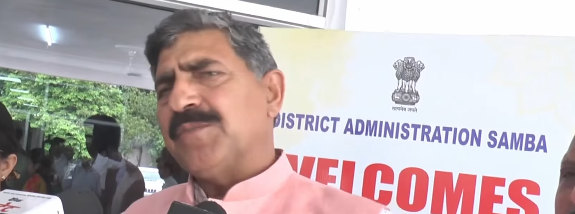
15 May: A meeting of the District Development Coordination and Monitoring Committee (DISHA) was held in Samba district to review the progress of ongoing development projects and assess the status of delayed works across various sectors.
The meeting was chaired by Jugal Kishore Sharma at the District Headquarters in Samba and was attended by MLAs, senior officers, and officials from the district administration.
During the review, officials presented updates on infrastructure projects, welfare schemes, and public service initiatives being implemented in the district. The meeting focused on identifying delays, improving coordination among departments, and ensuring timely completion of development works for public benefit.
Addressing the officers during the session, Jugal Kishore Sharma stressed the importance of efficient implementation of government schemes and directed departments to accelerate pending projects. He underlined that developmental initiatives must reach the grassroots level without unnecessary delays so that citizens can directly benefit from government programmes.
The DISHA committee serves as an important monitoring mechanism aimed at reviewing centrally sponsored schemes and major public development projects at the district level. Such meetings are intended to strengthen accountability, improve inter-departmental coordination, and address bottlenecks affecting project execution.
Officials reportedly discussed works related to road connectivity, public infrastructure, healthcare facilities, rural development, water supply, and welfare schemes currently underway in Samba district.
A major highlight of the programme was the distribution of sanction letters to five women beneficiaries under Mission Yuva, a government initiative focused on promoting self-employment and entrepreneurship among youth and women.
The beneficiaries received support aimed at helping them establish small livelihood ventures and become financially self-reliant. Officials said the initiative is part of broader efforts to encourage women empowerment, skill development, and economic participation at the grassroots level.
The inclusion of women beneficiaries during the programme reflected the growing focus on linking development initiatives with employment generation and social empowerment. Government schemes centred around entrepreneurship and self-employment have increasingly become an important component of rural and semi-urban economic development strategies in Jammu and Kashmir.
Observers note that such initiatives can play a meaningful role in strengthening local economies, particularly when combined with financial assistance, training, and market support mechanisms.
The meeting also highlighted the administration’s emphasis on improving the pace of developmental activities in the district. Public representatives raised concerns related to pending works and urged departments to maintain transparency and coordination while implementing projects.
Officials assured the committee that efforts are being made to resolve administrative delays and ensure better monitoring of development programmes.
The DISHA review in Samba comes amid ongoing efforts by the government to strengthen infrastructure, welfare delivery, and grassroots-level governance across Jammu and Kashmir. Regular monitoring meetings are seen as essential for evaluating the progress of public projects and ensuring that government resources are utilised effectively.
The programme concluded with directions for departments to maintain regular follow-up on pending works and ensure faster implementation of projects aimed at improving public services and regional development.