



















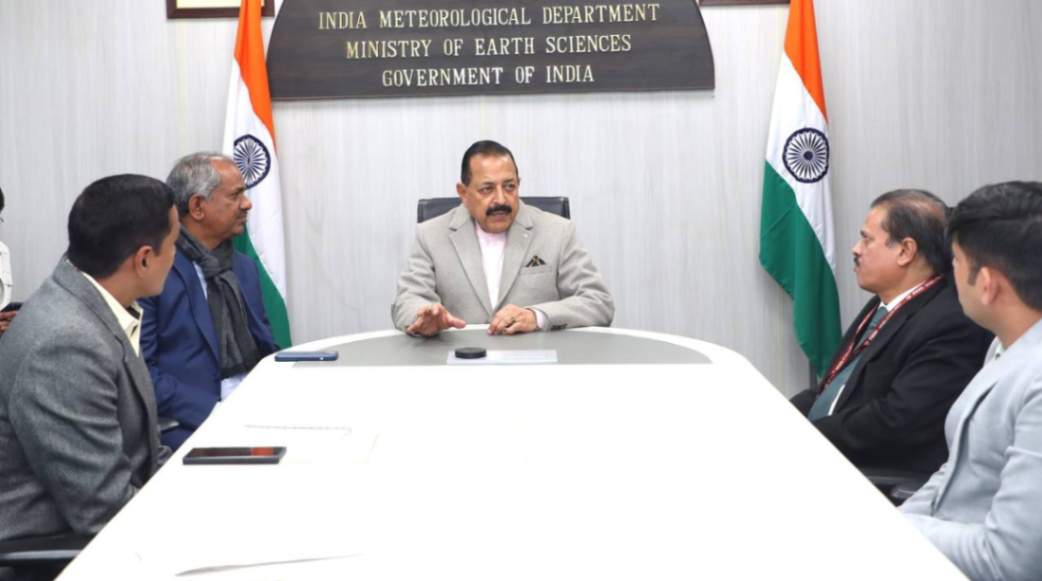
Jan 16: Union Minister of State (Independent Charge) for Science & Technology, Earth Sciences and MoS PMO, Dr. Jitendra Singh, today reviewed the progress of Mission Mausam, a flagship initiative aimed at strengthening India’s weather forecasting and disaster preparedness capabilities. The review focused on the expansion of Doppler Weather Radar (DWR) networks across the country and the implementation of impact-based weather forecasting systems.
During the review meeting, Dr. Jitendra Singh assessed how Mission Mausam is enhancing the accuracy and timeliness of weather predictions, particularly in the context of extreme weather events such as cyclones, heatwaves, floods, and intense rainfall. He underlined that reliable and early weather warnings are crucial for safeguarding lives, infrastructure, agriculture, and economic activity.
A key highlight of the review was the nationwide expansion of Doppler Weather Radars, which play a critical role in monitoring severe weather systems in real time. The Minister noted that improved radar coverage, especially in coastal, hilly, and disaster-prone regions, will significantly enhance India’s ability to track storms, cloudbursts, and localized weather phenomena with greater precision.
Dr. Jitendra Singh also evaluated the progress of impact-based forecasting, an advanced system that goes beyond predicting weather conditions to explaining their likely impact on communities, livelihoods, and critical services. Such forecasts help administrations and citizens take timely, informed decisions, reducing potential losses and improving disaster response mechanisms.
Emphasising inter-agency coordination, the Minister stressed the importance of seamless collaboration between scientific institutions, disaster management authorities, and state governments. He said that Mission Mausam reflects the government’s commitment to using science and technology for public good, ensuring that weather intelligence translates into actionable advisories at the grassroots level.
The Minister highlighted that strengthened forecasting capabilities will particularly benefit farmers, fishermen, aviation, disaster response agencies, and urban planners, enabling better planning and risk mitigation. He reiterated that climate change has made weather events more frequent and intense, making investments in advanced meteorological infrastructure both urgent and essential.
Mission Mausam is aligned with India’s broader vision of building climate resilience and leveraging indigenous scientific capacity to meet emerging challenges. Dr. Jitendra Singh directed concerned agencies to ensure timely implementation of remaining milestones and continuous upgradation of forecasting systems to meet global best practices.