


















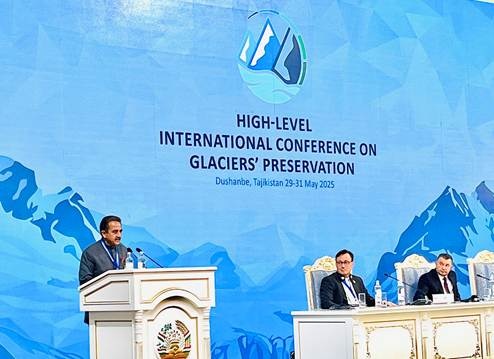
May 31: In a bold affirmation of its environmental stewardship, India has reiterated its steadfast commitment to glacier preservation and climate resilience on the global stage. At the High-Level International Conference on Glaciers’ Preservation in Dushanbe, Tajikistan, Union Minister of State for Environment, Forest, and Climate Change, Shri Kirti Vardhan Singh, delivered a compelling address that blended urgency, equity, and international cooperation.
Held from May 29–31, 2025, the conference convened global leaders, scientists, and policymakers to address the escalating threat of glacial retreat—a crisis that jeopardizes freshwater security, biodiversity, and the livelihoods of billions. Representing a nation deeply tied to the Himalayan ecosystem, Shri Singh emphasized that the melting of glaciers is not a distant threat but a present-day challenge with irreversible consequences.
India, he stated, is actively addressing the crisis through a series of forward-looking initiatives. Central to these efforts is the National Mission for Sustaining the Himalayan Ecosystem (NMSHE), under the National Action Plan on Climate Change (NAPCC), along with the establishment of a Centre for Cryosphere and Climate Change Studies. These institutions are advancing research, monitoring, and data-sharing to inform adaptive policy decisions.
Harnessing the power of science, India is deploying remote sensing and GIS technologies, spearheaded by ISRO, to track glacial mass and dynamics. Collaborative work by national agencies like the NCPOR, NIH, Wadia Institute, and GB Pant NIHE is reinforcing India’s capacity to respond with evidence-based strategies.
On the disaster preparedness front, India has implemented early warning systems and Glacial Lake Outburst Flood (GLOF) mapping, led by the NDMA, enhancing resilience in vulnerable mountain communities.
Shri Singh firmly echoed India’s adherence to the principle of Common but Differentiated Responsibilities and Respective Capabilities (CBDR–RC), highlighting the disproportionate climate vulnerability of South Asia despite its minimal historical emissions. Under Prime Minister Narendra Modi’s leadership, India has made notable progress on its Paris Agreement commitments, including a 36% reduction in GDP emission intensity and a dramatic shift toward non-fossil fuel energy sources.
Concluding his remarks, Shri Singh welcomed the global declaration of 2025 as the International Year of Glaciers’ Preservation and the Decade of Cryospheric Sciences (2025–2034). He called for deeper collaboration, shared innovation, and increased climate financing to ensure that developing countries are equipped to protect these fragile, life-sustaining ecosystems.