
















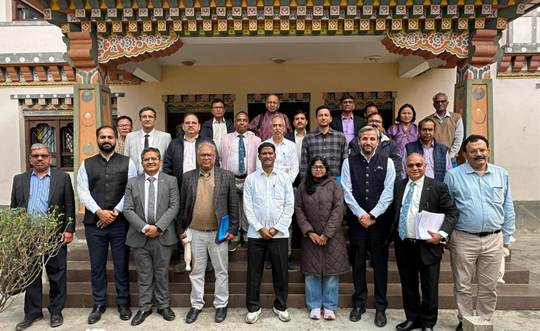
India and Bhutan have reaffirmed their longstanding partnership in water resources management and hydropower development during a high-level visit led by Shri V. L. Kantha Rao, Secretary, Department of Water Resources, River Development & Ganga Rejuvenation (DoWR, RD & GR), Ministry of Jal Shakti, Government of India.
The Indian delegation visited the Kingdom of Bhutan from 24–27 February 2026 to strengthen cooperation on transboundary rivers, review hydropower projects, and enhance flood forecasting and data-sharing mechanisms.
Strengthening Bilateral Water Cooperation
During the Secretary-level bilateral meeting held on 25 February 2026, both sides reviewed existing frameworks of cooperation in flood management and flood forecasting across shared river basins.
Discussions focused on:
-
Modernising the hydro-meteorological observation network in Bhutan
-
Improving real-time data sharing on transboundary rivers
-
Strengthening flood forecasting systems
-
Enhancing capacity building and technical exchanges
-
Addressing climate change-related challenges, including glacial lake outburst floods (GLOFs) and extreme weather events
These efforts are aimed at improving preparedness and resilience in downstream Indian states, particularly Assam and West Bengal, which are frequently affected by floods originating in upstream river systems.
Review of Punatsangchhu Hydropower Projects
A key highlight of the visit was the review of the Punatsangchhu-I Hydro Electric Project, which is being implemented in Bhutan with support from the Government of India.
The Secretary also visited the recently commissioned Punatsangchhu-II Hydroelectric Project and held detailed discussions with officials of PHPA-I and PHPA-II to assess progress and operational aspects.
Hydropower cooperation remains a cornerstone of India–Bhutan bilateral relations. These projects not only contribute significantly to Bhutan’s revenue and economic development but also strengthen India’s clean energy portfolio.
Engagements in Thimphu and Wangdue Phodrang
As part of the technical visit, the delegation toured several important institutions and facilities, including:
-
The National Center for Hydrology and Meteorology (NCHM) in Thimphu
-
The 3.5 MLD Water Treatment Plant at Chamgang
-
The NCHM flood monitoring station near Wangdue Phodrang Dzong
These visits focused on strengthening hydrological monitoring systems and integrating advanced forecasting tools to better manage shared river basins.
Courtesy Call on Bhutan’s Energy Minister
Following the bilateral discussions, Shri V. L. Kantha Rao paid a courtesy call on H.E. Lyonpo Gem Tshering, Hon’ble Minister for Energy and Natural Resources of Bhutan.
The meeting reaffirmed the shared commitment of both nations to the sustainable and mutually beneficial management of transboundary water resources.
Advancing Climate Resilience in Shared River Basins
With growing concerns over climate change, glacial melt, and extreme rainfall events in the Himalayan region, both countries acknowledged the need for modernised monitoring networks and enhanced data-sharing frameworks.
The visit emphasized:
-
Proactive flood risk management
-
Strengthened early warning systems
-
Climate-resilient infrastructure
-
Long-term sustainability of hydropower assets
India conveyed its continued support for deepening cooperation in water resources management, hydropower development, and disaster resilience.
A Model of Regional Cooperation
India–Bhutan cooperation in hydropower and river basin management is widely regarded as a successful model of regional collaboration. The February 2026 visit further consolidates this partnership by aligning energy security, environmental sustainability, and climate adaptation goals.
As both nations navigate the challenges of climate variability and rising water-related risks, enhanced coordination on transboundary rivers will remain central to ensuring shared prosperity and regional stability.