



















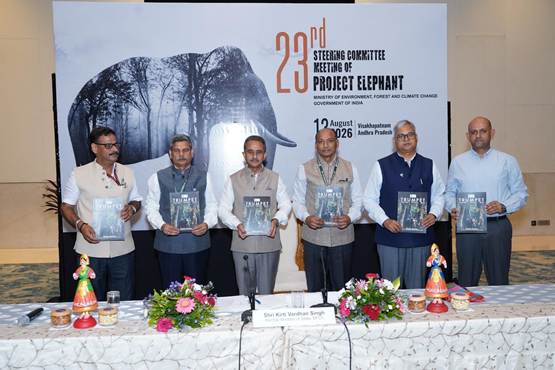
Visakhapatnam, August 13, 2026: India marked World Elephant Day 2026 with a national celebration in Visakhapatnam, reaffirming the country’s commitment to elephant conservation, habitat protection and reducing human-elephant conflict through science, technology and community participation.
The event was presided over by Union Minister of State for Environment, Forest and Climate Change Kirti Vardhan Singh, while Andhra Pradesh Deputy Chief Minister K. Pawan Kalyan attended as the Guest of Honour. Senior officials from the Centre and Andhra Pradesh Forest Department, along with representatives from the Railways, scientific institutions and other stakeholders, participated in the programme.
Focus on Technology and Community Participation
Addressing the gathering, Kirti Vardhan Singh highlighted the use of artificial intelligence, remote sensing and geospatial mapping, alongside traditional knowledge, to strengthen elephant conservation and habitat protection.
He stressed that human-elephant conflict is a complex issue that requires coordinated action involving governments, local communities, scientific institutions and other stakeholders. The minister also emphasised the importance of using scientific data validated through ground-level experience to develop effective solutions.
India currently has 33 Elephant Reserves and 150 scientifically identified elephant corridors and is home to nearly 60 per cent of the world’s wild Asian elephant population, according to the Ministry of Environment, Forest and Climate Change.
‘Conflict to Coexistence’ Approach in Andhra Pradesh
Deputy Chief Minister K. Pawan Kalyan said Andhra Pradesh is following the principle of “Conflict to Coexistence” while addressing human-elephant conflict.
He highlighted the state’s H.A.N.U.M.A.N. initiative — Healing And Nurturing Units for Monitoring, Aid and Nursing of Wildlife — and spoke about the use of technology, community engagement and capacity building of frontline forest personnel to strengthen wildlife protection.
Gaj Gaurav Awards 2026 Presented
A major highlight of the celebrations was the presentation of the Gaj Gaurav Awards 2026 to individuals recognised for their contributions to elephant conservation and management.
The event also saw the release of “30 Giant Steps,” documenting major milestones and conservation initiatives under Project Elephant between 2020 and 2026. Project Elephant was launched in 1992 as a Centrally Sponsored Scheme to protect elephants, their habitats and corridors, address human-elephant conflict and support the welfare of captive elephants.
Southern India Gets Regional Action Plan
A Regional Action Plan for Comprehensive Understanding and Management of Human-Elephant Conflict in Southern India was also released. The plan covers Karnataka, Kerala, Andhra Pradesh and Tamil Nadu and adopts a landscape-level approach to managing conflict.
Supported by ₹500 crore from the Government of India, the plan focuses on habitat connectivity, corridor conservation, early-warning systems, conflict mitigation infrastructure, habitat restoration, community participation, research and monitoring, rapid response mechanisms and stronger coordination between states.
Students Join Wildlife Awareness Campaign
As part of the nationwide World Elephant Day activities, Project Elephant and the National Museum of Natural History conducted awareness programmes involving more than 20 lakh students across 21,450 schools.
Activities included painting and mask-making competitions, rallies, street plays, awareness programmes and pledge-taking ceremonies aimed at helping children understand the ecological and cultural importance of elephants and the need to protect their habitats.
The World Elephant Day celebrations reaffirmed India’s broader conservation approach, combining technology, habitat and corridor protection, scientific research and community participation to support healthy elephant populations and resilient forest ecosystems.