














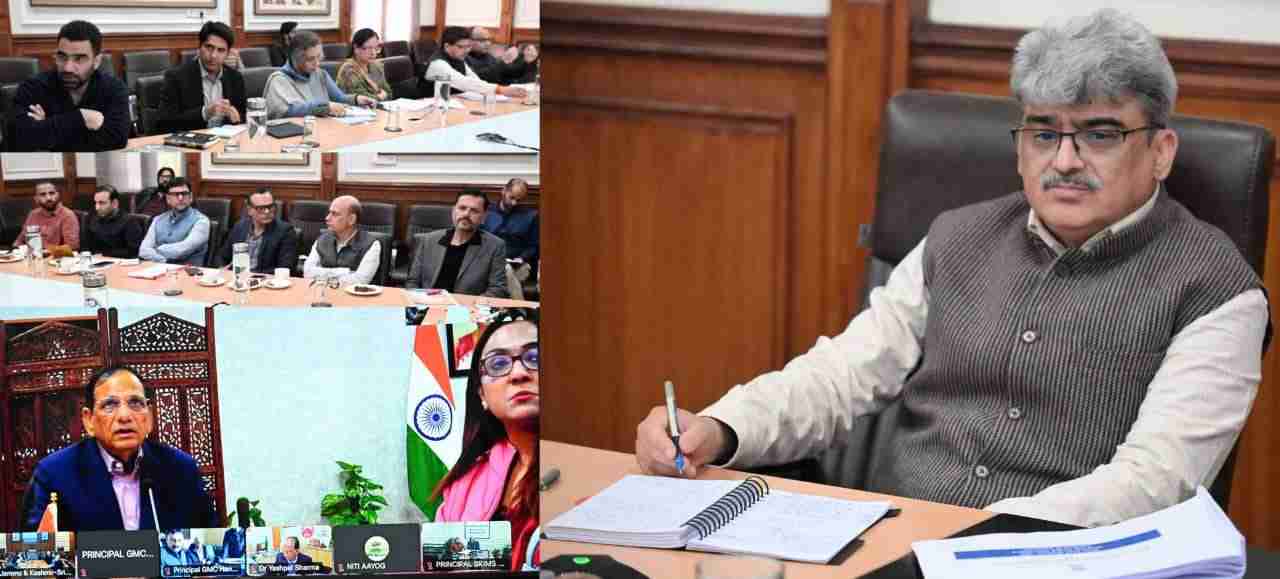
NOV 29:The Jammu and Kashmir administration has intensified its efforts to curb the growing challenge of substance abuse, with Chief Secretary Atal Dulloo convening a high-level strategic consultation with Dr. V.K. Paul, Member of NITI Aayog. The meeting was aimed at seeking expert guidance to develop a more resilient, comprehensive, and sustainable roadmap to counter drug addiction across the Union Territory.
During the session, medical specialists from the All India Institute of Medical Sciences (AIIMS) and the Postgraduate Institute of Medical Education and Research (PGIMER) shared a range of proven national and international best practices. These included advanced approaches to clinical treatment, effective counselling mechanisms, scientific rehabilitation models, and community support systems that have shown promising results in various parts of the country. Their inputs highlighted the importance of early intervention, professional counselling, improved mapping of addiction patterns, and robust follow-up mechanisms to ensure long-term recovery.
Chief Secretary Dulloo emphasised that combating drug abuse requires much more than policing and enforcement; it demands an all-inclusive societal response. He advocated for a community-centric, multi-dimensional approach that integrates education, awareness, healthcare, law enforcement, and social support. Strengthening collaboration between government departments, civil society organisations, educational institutions, and healthcare providers was identified as essential for creating an ecosystem that prevents addiction and supports individuals in recovery.
Dulloo reaffirmed the UT government’s commitment to building a healthier, more resilient society by prioritising both prevention and rehabilitation. He also underlined the need for sustained outreach programmes, capacity-building of frontline workers, and enhanced de-addiction infrastructure across districts.
The consultation marked an important step in aligning Jammu and Kashmir’s anti-drug strategy with national best practices and expert recommendations. With continued institutional support, data-driven interventions, and active community engagement, the administration aims to advance towards a drug-free future for the Union Territory.