


















Minister Satish Sharma Unveils 143 KW Solar Rooftop Plant at JK Cable Car Corporation
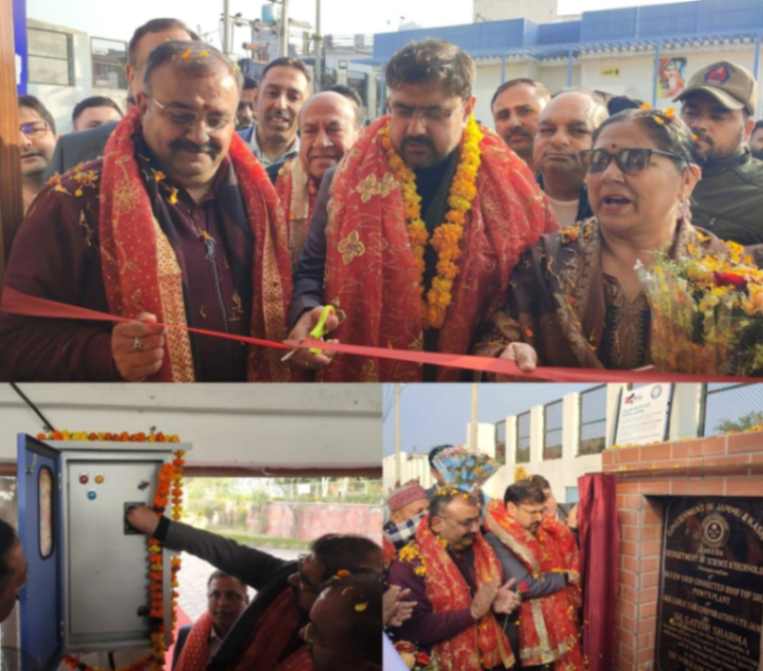
DEC 3:In a significant push toward expanding Jammu & Kashmir’s renewable energy footprint, Minister Satish Sharma inaugurated a 143 KW grid-connected rooftop solar power plant at the Jammu & Kashmir Cable Car Corporation (JKCCC). Implemented by the Jammu & Kashmir Energy Development Agency (JAKEDA), the project represents a major milestone in the region’s transition toward sustainable and low-carbon energy solutions.
The newly commissioned solar installation is expected to dramatically reduce the corporation’s dependence on conventional energy, cut operational costs, and contribute to the Union Territory’s long-term climate goals.
A Major Step Toward Strengthening J&K’s Renewable Ecosystem
Speaking at the launch event, Minister Satish Sharma highlighted that the rooftop solar plant is part of the government’s broader mission to make Jammu & Kashmir a leader in green energy adoption. He noted that the administration is committed to encouraging both government institutions and private establishments to shift toward clean, affordable and renewable energy systems.
The Minister emphasized that such projects help decrease the region’s carbon emissions, support environmental conservation, and align Jammu & Kashmir with national and global climate targets. He stressed that increased adoption of rooftop solar can significantly reduce the power burden on the local grid while ensuring greater energy reliability.
Project Implemented by JAKEDA: A Model for Future Solar Expansion
JAKEDA, the nodal agency responsible for advancing renewable energy initiatives across J&K, spearheaded the installation of this 143 KW solar plant. Officials explained that the system is designed with high-efficiency solar modules and advanced inverters to ensure optimal power generation throughout the year.
The project is expected to:
-
Reduce annual electricity expenditure for JKCCC
-
Promote self-sustainability in government energy consumption
-
Serve as a demonstration model for other institutions
-
Encourage wider adoption of rooftop solar across the UT
The agency reaffirmed its commitment to supporting more government departments, public facilities and community spaces in integrating renewable systems into their infrastructure.
Promoting Large-Scale Rooftop Solar Adoption
Minister Sharma urged government institutions, commercial establishments and households to take advantage of the incentives and subsidies available for solar installations. He stated that rooftop solar is not only a clean energy alternative but also a strategic investment that brings long-term economic savings.
He added that the government plans to scale up such initiatives to ensure that solar power becomes an integral part of Jammu & Kashmir’s energy architecture, contributing to energy independence and environmental sustainability.
Towards a Greener and More Energy-Efficient Jammu & Kashmir
The inauguration of the rooftop solar plant at JKCCC marks a forward-looking shift in the UT’s energy priorities. By combining technology, innovation and policy support, the project lays the foundation for a greener, more energy-efficient and climate-resilient Jammu & Kashmir.
The event concluded with a call for collective participation in renewable energy adoption, reinforcing the vision of creating a sustainable future powered by clean and reliable energy sources