












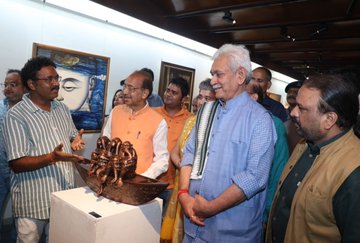
JULY 17: Lieutenant Governor of Jammu & Kashmir, Shri Manoj Sinha, addressed a seminar in New Delhi today on “J&K’s March Towards Peace,” as part of a lecture series hosted by Gandhi Smriti. Highlighting the ongoing transformation in the Union Territory, he emphasized how Mahatma Gandhi’s principles continue to inspire the region’s journey toward peace, unity, and development.
Shri Sinha remarked that the Union Territory’s educational institutions are now playing a key role in instilling Gandhian values among the youth—especially truth, non-violence, and compassion. These virtues, he said, are vital in building a resilient and harmonious society.
He praised the leadership of Prime Minister Shri Narendra Modi, stating that since the abrogation of Article 370 in 2019, the Union Government has made consistent efforts to establish a fear-free and terror-free Jammu and Kashmir. According to the LG, these initiatives are directly aligned with Mahatma Gandhi’s vision of a peaceful and inclusive India.
Highlighting a symbolic annual initiative, Shri Sinha noted that every year, a month-long peace march is conducted in the Kashmir Valley to commemorate the birth anniversary of Mahatma Gandhi. This march, he said, has become a powerful expression of the region’s desire to reclaim its historical identity as a land of peace and spiritual richness.
“The youth of Jammu and Kashmir are now more aware than ever of their role in building a peaceful future. The vision of J&K that Bapu had—a land united in harmony—is gradually becoming a reality,” he said.
However, LG Sinha also pointed out that Pakistan, frustrated by the positive changes in J&K, continues to make attempts to destabilize the region. Referring to the recent terrorist attack in Pahalgam, he said the intent was not just to incite fear but also to obstruct the UT’s economic advancement.
Despite such challenges, Shri Sinha reaffirmed that Jammu and Kashmir is moving forward with renewed determination and strength, guided by the ideals of Mahatma Gandhi and the unwavering commitment of the central leadership.