


















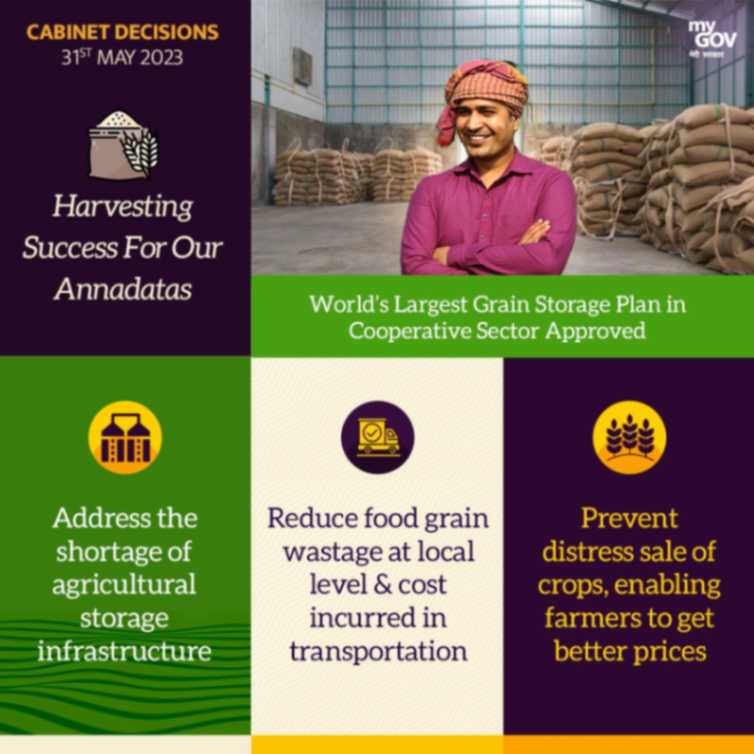
Feb 11: The Government of India’s ambitious World’s Largest Grain Storage Plan in the Cooperative Sector (WLGSP) has achieved a major milestone with the successful completion of its pilot project in Balaghat district of Madhya Pradesh.
In a written reply in the Rajya Sabha, Union Minister for Home and Cooperation Amit Shah informed that Balaghat was selected as the pilot district under the plan. As part of the initiative, a 500 metric tonne (MT) godown was constructed at Bahudeshiya Prathamik Krishi Saakh Sahakari Society Maryadit Parswada. The facility was inaugurated by Prime Minister Narendra Modi on 24 February 2024 and has been hired by the Madhya Pradesh Warehousing and Logistics Corporation (MPWLC).
Convergence of Multiple Central Schemes
The World’s Largest Grain Storage Plan is being implemented at the level of Primary Agricultural Credit Societies (PACS) and other cooperative societies through the convergence of various existing Government of India schemes. These include:
-
Agriculture Infrastructure Fund (AIF)
-
Agricultural Marketing Infrastructure Scheme (AMI)
-
Sub Mission on Agricultural Mechanization (SMAM)
-
Pradhan Mantri Formalization of Micro Food Processing Enterprises Scheme (PMFME)
Under the AIF scheme, PACS receive interest subvention benefits on loans taken for constructing godowns. Additionally, the loan repayment period has been extended from 2+5 years to 2+8 years, offering greater financial flexibility.
Significant reforms have also been introduced under the AMI scheme:
-
Margin money requirement reduced from 20% to 10%
-
Construction cost revised to ₹7,000/MT for plain areas and ₹8,000/MT for northeastern states
-
Subsidy for PACS increased from 25% to 33.33%
-
Additional subsidy provision for ancillary infrastructure such as internal roads, weighbridges, and boundary walls
These measures are designed to make storage infrastructure more accessible and financially viable for cooperative institutions.
Reducing Post-Harvest Losses and Distress Sales
The decentralised storage model under WLGSP aims to transform India’s agricultural supply chain. By enabling scientific storage facilities at the village and PACS level, the plan is expected to significantly reduce post-harvest losses.
Local storage reduces the need for repeated long-distance transportation to mandis or large warehouses, thereby lowering logistics costs. Farmers can store their produce locally and access pledge financing, allowing them to sell at favourable market prices rather than being forced into distress sales.
This is particularly beneficial for small and marginal farmers, who often lack the financial cushion to hold their produce until prices improve.
Strengthening Food Security and Supply Chain Efficiency
The decentralised grain storage system will enhance price realisation for farmers, improve supply chain efficiency and contribute to national food security goals. By integrating infrastructure support with cooperative reforms, the government aims to empower PACS as multi-functional service centres in rural India.
The completion of the Balaghat pilot marks a crucial step toward scaling up the World’s Largest Grain Storage Plan nationwide, reinforcing the cooperative movement and strengthening India’s agricultural backbone.