


















JULY 04: In a breakthrough blending nanotechnology and optics, scientists at the Centre for Nano and Soft Matter Sciences (CeNS), Bengaluru, have developed tunable color-shifting materials using tiny plastic spheres—paving the way for next-generation wearable sensors, anti-counterfeit features, sustainable paints, and display technologies.
This innovation draws inspiration from nature. Much like the iridescent hues on a peacock’s feathers or a butterfly’s wings, the colors in this material are not produced by dyes or pigments, but by nanoscale structures that reflect light in specific ways—a phenomenon known as structural coloration.
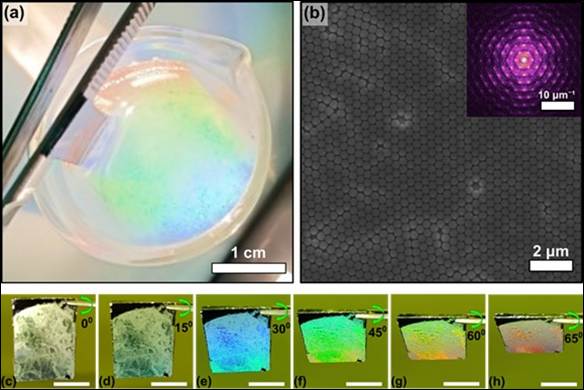
At the core of the research are polystyrene (PS) nanospheres, each about 400 nanometers wide—around 200 times smaller than the width of a human hair. When these spheres are placed on a water surface, they naturally self-assemble into a close-packed, hexagonal pattern. This self-organization at the air-water interface forms a monolayer that behaves like a precise optical surface.
The team then employed reactive ion etching, a gentle nano-sculpting process, to reduce the size of the spheres while maintaining their ordered structure. This subtle change transforms the arrangement into a non-close-packed configuration, dramatically affecting how light interacts with the surface.
As light hits this nanostructured layer, different wavelengths are selectively reflected or suppressed based on viewing angle and sphere spacing. The result: vivid structural colors that shift—typically toward blue—as the angle changes. Unlike traditional dyes, which degrade over time or under UV exposure, these structural colors are durable, vibrant, and eco-friendly.
What makes this innovation even more significant is its scalability and cost-effectiveness. The CeNS researchers used a bottom-up fabrication method, allowing natural forces to drive the self-assembly of nanospheres. This process, combined with minimal post-processing, holds promise for mass production of advanced optical materials.
Their findings, published in the Journal of Applied Physics, demonstrate how controlling particle size and geometry enables finely tuned, angle-dependent optical behavior. The study also provides insights into scalable fabrication techniques for customizable photonic surfaces, relevant to both industrial and consumer applications.
By harnessing the interaction of light with nanoscale geometry, CeNS scientists have opened up exciting avenues in the development of functional, sustainable, and intelligent materials for tomorrow’s technology.

)