



















5 May, 2026:
The reopening of the Civil Secretariat in Srinagar is not merely a routine administrative transition; it signals a renewed emphasis on accountability and performance-driven governance under Chief Minister Omar Abdullah.

CM receives warm welcome by Cabinet Ministers
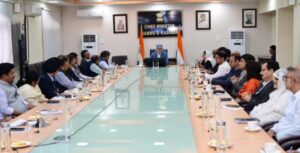
At the start of the new administrative cycle, the Chief Minister convened a high-level meeting with Administrative Secretaries. He was joined by Deputy Chief Minister Surinder Kumar Choudhary, along with Cabinet Ministers Sakina Itoo, Javid Ahmad Dar, Javed Ahmed Rana, and Satish Sharma, besides the Advisor to the Chief Minister. The gathering reflected a collective intent to recalibrate governance priorities as the administration resumes full-scale functioning in the Valley.

Cabinet Ministers in a meeting
During the meeting, the Chief Minister underlined three critical priorities: speedy execution of projects, effective implementation of decisions, and seamless coordination between departments. These elements, though often discussed, remain central to addressing long-standing administrative delays and inefficiencies in the region.
What stood out in his remarks was a clear push to move governance from intent to outcome. Developmental initiatives in Jammu and Kashmir have frequently faced hurdles due to fragmented execution and procedural delays. By stressing timelines and accountability, the leadership is attempting to ensure that policies result in tangible benefits on the ground.
The emphasis on inter-departmental coordination also carries weight. Governance challenges rarely fall within the scope of a single department, and a lack of alignment often slows progress. The Chief Minister’s direction signals an understanding that collaborative functioning is essential for delivering meaningful results.
Another practical concern addressed during the review was the need to improve the administrative infrastructure. The Estates Department was directed to ensure proper residential arrangements and workplace facilities for employees. While this may appear routine, it highlights a fundamental truth: efficient governance requires a system that is itself well-supported and functional.
Beyond the formal meeting, the Chief Minister’s actions added a significant dimension to the day’s developments. In a proactive move, he personally visited the offices of all Cabinet Ministers within the Secretariat. This step went beyond symbolism, reflecting a governance approach that values direct observation and engagement.

CM visits Minister Satish Sharma Office

CM visits Minister Surinder Kumar Choudhary Office
Such visits provide an opportunity to assess conditions on the ground, identify operational gaps, and reinforce accountability across departments. They also send a clear message to the administrative machinery that leadership is actively involved and attentive to details.
The reopening of the Srinagar Secretariat, traditionally linked to the Darbar Move, has always marked an important administrative phase. However, the early review and direct outreach this time suggest an effort to eliminate the usual inertia and ensure that governance begins at full pace.
With a Cabinet handling diverse and critical sectors from infrastructure and agriculture to education and technology, the focus now shifts to translating administrative intent into visible improvements for the public.
Expectations among citizens are steadily rising. People are increasingly looking for timely services, completed projects, and transparent functioning. The Chief Minister’s emphasis on delivery and coordination aligns with these expectations, but its success will depend on sustained implementation.
Consistency remains the key challenge. Directives must be supported by continuous monitoring, accountability systems, and measurable benchmarks. Without these, even the most determined initiatives risk losing momentum over time.
At a broader level, Jammu and Kashmir is at a crucial stage of administrative and developmental evolution. Governance, therefore, is not limited to policy decisions; it is about building credibility, ensuring stability, and delivering outcomes that people can see and trust.
The developments at the Civil Secretariat indicate an awareness of these realities. By combining structured reviews with direct engagement, the administration is attempting to establish a more responsive and outcome-oriented governance model.
Whether this approach leads to lasting change will become evident in the months ahead. For now, the direction is clear: governance in Jammu and Kashmir is expected to be proactive, coordinated, and firmly focused on results.