



















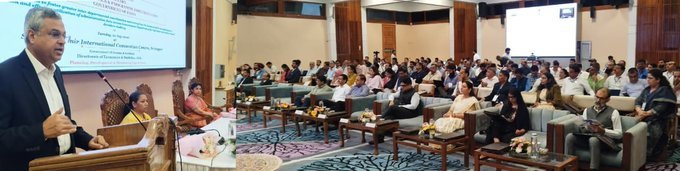
Srinagar, September 2, 2026: A UT-level workshop on “Administrative Data Harmonisation” was held at the Sher-i-Kashmir International Convention Centre (SKICC), Srinagar, with a focus on improving the quality, consistency and usability of administrative data for governance and statistical decision-making.
The workshop was chaired by Dr. Saurabh Garg, Secretary, Ministry of Statistics and Programme Implementation (MoSPI), and organised by the Directorate of Economics & Statistics (DES), Jammu & Kashmir.
Focus on Better Data Standards
The workshop brought attention to the need for greater consistency in the way administrative data is collected, classified and maintained across government departments.
Discussions centred on harmonising data concepts, standards and classifications so that information generated by different administrative systems can be compared and used more effectively.
Such harmonisation can help improve interoperability, statistical quality and data comparability, making it easier for institutions to combine information from different sources for planning and policy formulation.
Making Administrative Data AI-Ready
An important aspect of the workshop was the growing relevance of Artificial Intelligence in public administration.
Participants explored how administrative datasets could be structured and prepared to become AI-ready, allowing them to support advanced analytics and evidence-based governance.
Well-standardised and interoperable datasets can provide a stronger foundation for data-driven decision-making, while helping government institutions identify trends, assess programmes and improve the delivery of public services.
Kutumba Initiative Offers Digital Governance Insights
The discussions also examined the Kutumba initiative, which provides insights into the development of integrated digital family registries.
The initiative was highlighted in the context of linking information in a structured manner to create a more integrated understanding of households and families. Such digital registries can offer useful lessons for developing interconnected administrative databases while improving the availability of information for governance.
Strengthening Evidence-Based Governance
The workshop underlined the importance of treating administrative data as a strategic resource for modern governance.
By bringing together common standards and classifications, government agencies can reduce inconsistencies and improve the reliability of information used for official statistics and policymaking.
The emphasis on AI-readiness also reflects the changing nature of public administration, where high-quality and well-structured data is increasingly important for deploying advanced analytical tools.
The Srinagar workshop thus provided a platform for officials and statistical institutions to discuss how Jammu & Kashmir can strengthen its administrative data ecosystem and move towards more integrated, interoperable and evidence-based governance.