


















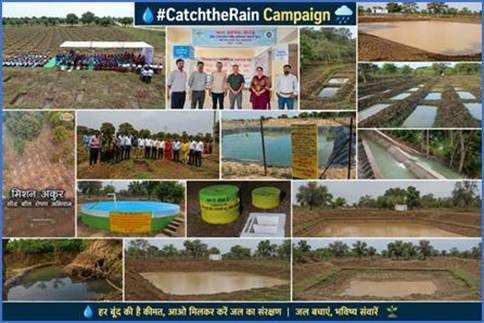
India’s water conservation efforts are increasingly moving beyond government-led infrastructure to community-driven action, with Jal Sanchay Jan Bhagidari (JSJB) emerging as a nationwide model for rainwater harvesting, groundwater recharge and local water management.
From Traditional Wisdom to Modern Water Conservation
For generations, Indian communities relied on stepwells, ponds, tanks, johads and traditional irrigation systems to conserve water. The same spirit of collective responsibility is now being combined with modern technology and scientific planning through JSJB.
Launched on September 6, 2024, the initiative places public participation at the centre of water conservation. Its approach focuses on affordable groundwater recharge and storage structures, revival of defunct borewells and locally suitable solutions.
The programme is guided by the 3Cs — Community, CSR and Cost, bringing citizens, institutions and corporate social responsibility efforts together.
More Than 1.58 Crore Recharge Structures
The scale of the initiative has expanded rapidly. Under JSJB 1.0, more than 27 lakh water conservation structures had been created by May 2025. Following the launch of JSJB 2.0 in June 2025, the number of groundwater recharge structures crossed 1.5 crore by May 2026.
In June 2026, JSJB was integrated with the Jal Shakti Abhiyan: Catch the Rain campaign as Jal Sanchay Jan Bhagidari: Catch the Rain (JSJB: CTR).
As of September 3, 2026, more than 1.58 crore artificial groundwater recharge structures have been constructed across the country.
Centre-State Cooperation Gets Fresh Push
The Ministry of Jal Shakti’s Departmental Summit held in New Delhi on September 1–2 placed JSJB: Catch the Rain among its four major thematic areas.
Prime Minister Narendra Modi emphasised greater public participation through initiatives such as “Jal Utsav”, along with stronger water-management education in universities and higher educational institutions.
He also highlighted the importance of inter-State learning visits and better use of water-related data to improve planning and governance.
Chhattisgarh Farmers Create Space for Water
In Korea district of Chhattisgarh, farmers have demonstrated how local participation can transform groundwater management.
Through the Aawa Paani Jhoki movement, farmers voluntarily allocated 5 percent of their agricultural land for recharge ponds and terraced pits. More than 1,260 farmers adopted the model, while over 2,000 soak pits were created.
Several villages recorded groundwater-level improvements of around 3 to 4 metres, while springs were revived in 17 remote tribal hamlets.
The initiative combined farmer ownership with technical support, including watershed mapping and hydrogeological assessments.
Andhra Pradesh Villages Turn to Collective Water Planning
In Prakasam district, villages including Murugummi, Marella and Thangella adopted community-based approaches after facing irregular rainfall, falling groundwater levels and borewell failures.
Gram Sabhas, awareness campaigns, Kalajathas and workshops brought farmers, women, youth and local institutions together to discuss water budgeting, crop planning and groundwater sharing.
Using a ridge-to-valley approach, the villages developed structures to capture and recharge rainwater.
Murugummi created 71 conservation structures with around 8.11 lakh cubic metres of cumulative storage capacity, supporting irrigation across 264.5 hectares. Marella developed 53 structures with nearly 10.04 lakh cubic metres of storage, while Thangella created 71 structures providing approximately 5.89 lakh cubic metres.
Together, these measures have improved water availability for nearly 5,900 people and strengthened agricultural and dairy livelihoods.
Odisha Links Rooftops With Underground Aquifers
Odisha is combining institutional participation with groundwater recharge through the CHHATA and ARUA schemes.
In Jajpur district, 117 recharge shafts were created under ARUA and 114 rooftop rainwater harvesting systems were installed under CHHATA between 2022–23 and 2025–26.
Similar interventions in Cuttack and Ganjam have brought government offices, schools, self-help groups, students and Panchayati Raj Institutions into the conservation effort.
In Digapahandi, where groundwater levels had declined by 1–3 metres between 2020 and 2022, rooftop harvesting systems are helping channel rainwater into recharge borewells, with assessments indicating improved post-monsoon recovery around intervention areas.
Building Water Security One Community at a Time
The larger message of JSJB is that water conservation cannot depend solely on large infrastructure projects. Community ownership, scientific planning and local knowledge must work together.
From farmers dedicating land for recharge structures to schools harvesting rooftop rainwater, the initiative demonstrates how small local interventions can contribute to a much larger national objective.
As India works towards Viksit Bharat 2047, the Jal Sanchay Jan Bhagidari model underlines a simple principle: conserving every drop becomes more effective when water security becomes a shared responsibility.

