


















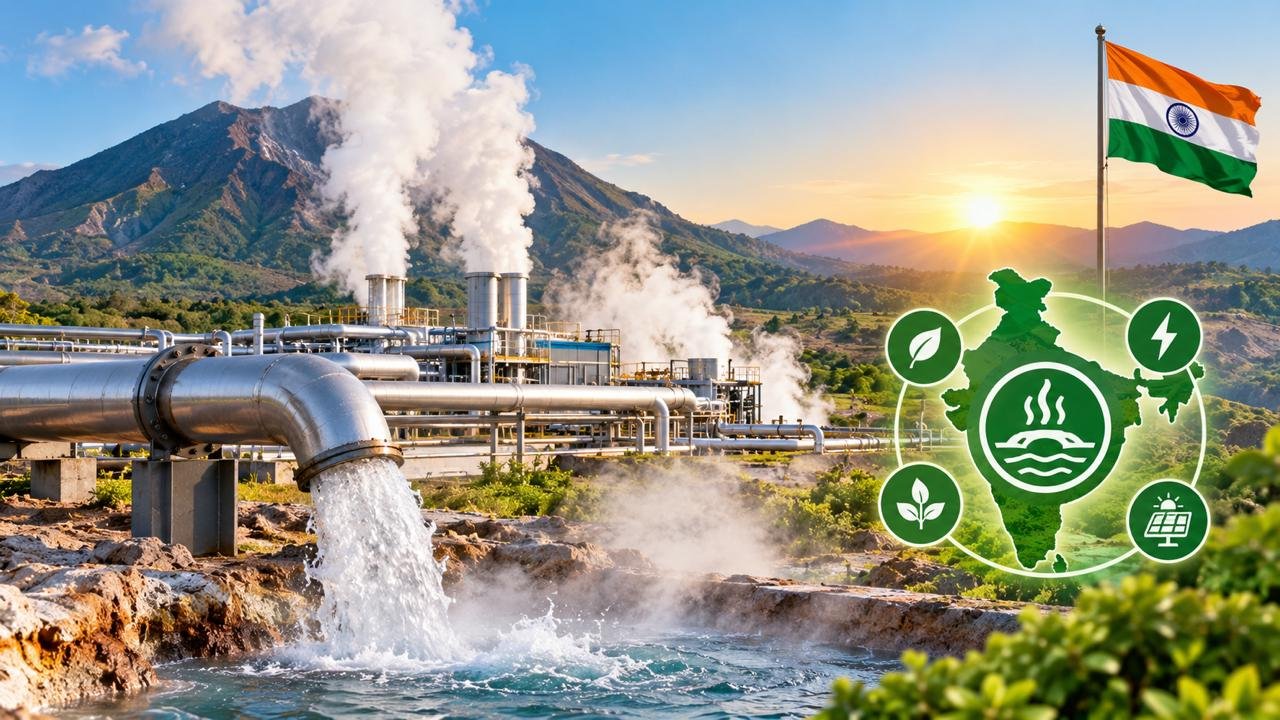
New Delhi: India is turning its attention towards geothermal energy as it seeks to build a cleaner, more reliable and diversified energy system. With the government working to develop the country’s geothermal resources, the sector could eventually provide a steady source of electricity as well as heat and cooling for a range of applications.
Unlike solar and wind power, geothermal energy is not dependent on sunshine or wind conditions. It uses heat stored deep inside the Earth and can potentially operate around the clock, making it an attractive option for strengthening India’s renewable energy mix.
National Policy Gives Geothermal Energy a Framework
A major step came in September 2025, when the government notified the National Policy on Geothermal Energy. The policy provides a framework for systematic exploration, development and utilisation of geothermal resources, with the Ministry of New and Renewable Energy (MNRE) serving as the nodal ministry.
The policy places emphasis on exploration, drilling, reservoir management, research and development and direct-use applications. It also encourages public and private sector participation, pilot projects and the creation of a national geothermal data repository.
Puga Valley Marks a Major Milestone
India reached an important stage in its geothermal journey in July 2026, when the ONGC Energy Centre commissioned two geothermal wells in Puga Valley, Ladakh.
Situated at an altitude of more than 14,000 feet, Puga is regarded as one of India’s promising geothermal locations because of its hot springs and underground heat resources.
The two wells, each around 1,000 metres deep, are intended to support reservoir assessment and the development of India’s first 1-MW demonstration geothermal power project.
The project is expected to generate valuable field experience as India evaluates the potential for larger-scale geothermal applications.
India Has Significant Geothermal Potential
The Geological Survey of India has mapped 381 hot springs and identified 10 geothermal provinces across the country.
India’s theoretical geothermal potential is estimated at nearly 10.6 GW, with 42 sites identified as promising for electricity generation and direct heat applications.
The identified geothermal provinces include the Himalayan region, Naga-Lusai, Andaman and Nicobar Islands, Son-Narmada-Tapi, West Coast, Cambay Graben, Aravalli, Mahanadi, Godavari and South Indian Cratonic regions.
New technologies such as Enhanced Geothermal Systems (EGS) and Advanced Geothermal Systems could potentially expand the areas where geothermal resources can be developed.
How Geothermal Energy Produces Power
Geothermal energy originates from the enormous amount of heat stored inside the Earth.
In areas where underground heat reaches accessible reservoirs, hot water and steam can be brought to the surface through wells. The steam or hot fluid can then be used to drive turbines connected to electricity generators.
After the energy is extracted, water can be condensed and reinjected into the underground reservoir. This helps maintain the resource and supports continued operation.
Geothermal heat does not have to be used only for electricity. It can also support district heating, agriculture, aquaculture and heating and cooling systems.
Old Oil and Gas Wells Could Find a New Use
India is also examining whether abandoned or unproductive oil and gas wells could be repurposed for geothermal applications where technically feasible.
Such an approach could make use of existing drilling knowledge, geological information and infrastructure from the oil and gas sector. If successful, it could reduce some of the challenges and costs associated with developing completely new geothermal sites.
Pilot Projects Expand Research Across India
India’s geothermal efforts are moving beyond resource mapping towards field-level demonstrations.
Between July and August 2025, MNRE sanctioned five research and development projects covering resource assessment, technology development and demonstrations for electricity, heating and cooling.
At Ankleshwar in Gujarat, a pilot project is examining electricity generation through the retrofitting of unproductive oil and gas wells.
In Gandhinagar, a solar-geothermal demonstration project has drilled three wells producing geothermal fluids at temperatures of around 70-80 degrees Celsius and demonstrated electricity generation of 50-90 kilowatts.
Research is also underway in Tawang, Arunachal Pradesh, where five geothermal locations are being studied. In Hyderabad, researchers are working on geothermal cooling and shallow geothermal systems for heating and cooling applications.
International Partnerships Could Accelerate Development
India is also exploring international cooperation in geothermal technology. Australia and Iceland have been identified as partners for collaboration in this field, while geothermal energy is also part of an MoU with Saudi Arabia.
Such partnerships could support knowledge exchange, technological development and capacity building as India develops its own geothermal ecosystem.
A Promising Addition to India’s Renewable Energy Mix
Geothermal energy is still at an early stage in India, and commercial-scale geothermal electricity generation has yet to be established. However, resource surveys, pilot projects, policy support and international cooperation are gradually creating the foundation for the sector.
With an estimated theoretical potential of nearly 10,600 MW, geothermal energy could eventually complement India’s solar and wind capacity with a dependable source of renewable energy.
Its applications could extend well beyond electricity to heating, cooling, agriculture, aquaculture and tourism. As India works towards its Net Zero target for 2070, geothermal energy could become another important component of the country’s long-term clean energy strategy.