




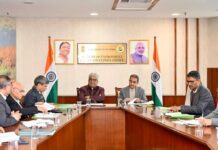








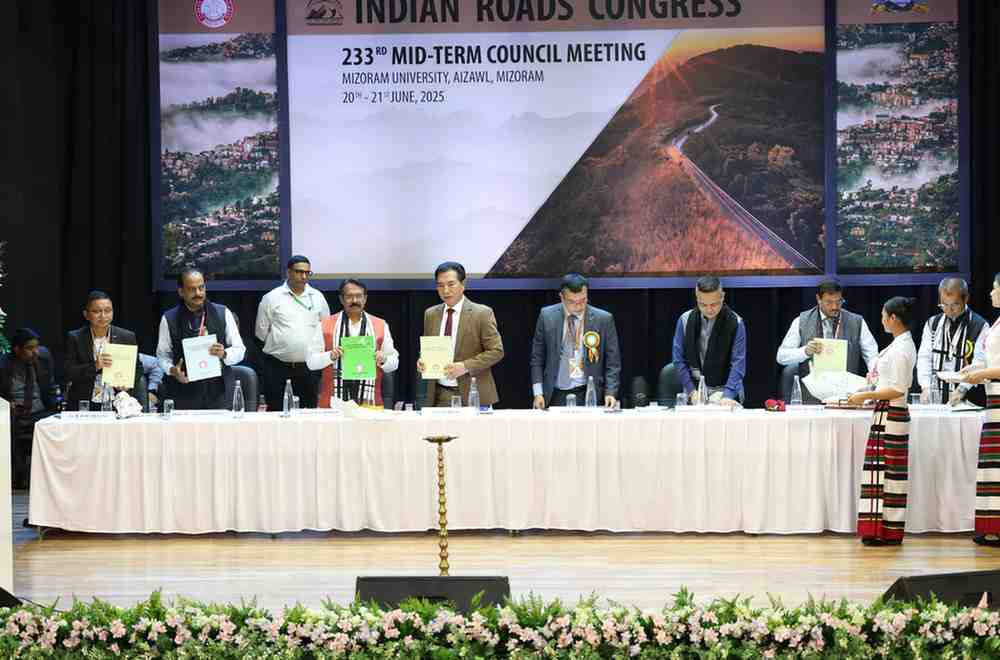
JUNE 20: Minister of State for Road, Transport & Highways and Corporate Affairs, Shri Harsh Malhotra, underlined the transformative socio-economic impact of infrastructure development, asserting that a strong and efficient road network serves as a catalyst for regional prosperity. Speaking at the 233rd Mid-Term Council Meeting of the Indian Roads Congress (IRC), held at the Mizoram University campus in Aizawl, he reiterated that infrastructure is central to realizing the Prime Minister’s vision of Viksit Bharat by the year 2047.
Shri Malhotra emphasized that economic development is intrinsically linked to infrastructure expansion, especially in regions like North East India. He noted that over the last 11 years, the length of National Highways in the country has increased by more than 60%, growing from 91,000 km in 2014 to approximately 1.47 lakh km in 2025.
In his address, the Minister highlighted the importance of embracing globally recognized construction technologies and reducing costs without compromising on quality. He urged for the adoption of eco-friendly practices and advanced methods in road construction to ensure sustainable growth.
Praising the Indian Roads Congress for its decades of contribution, Shri Malhotra lauded its evolution into a comprehensive institution comprising members from central and state governments, military engineering services, and the Border Roads Organization. He noted that construction work on National Highways follows standards set by the government and IRC, including safety and quality benchmarks.
Shri Malhotra also commended the significant infrastructure progress in the North Eastern region, pointing out that nearly 10,000 km of National Highways have been constructed in the last decade at a cost exceeding ₹1.07 lakh crore. These developments have dramatically improved connectivity to remote and border areas, aligning with the government’s focus on inclusive growth.
The Minister concluded by stating that infrastructure is far more than concrete and steel—it represents economic opportunity, social mobility, and the groundwork for a resilient, inclusive, and competitive India as envisioned in the Viksit Bharat mission.