






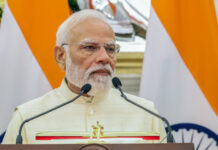





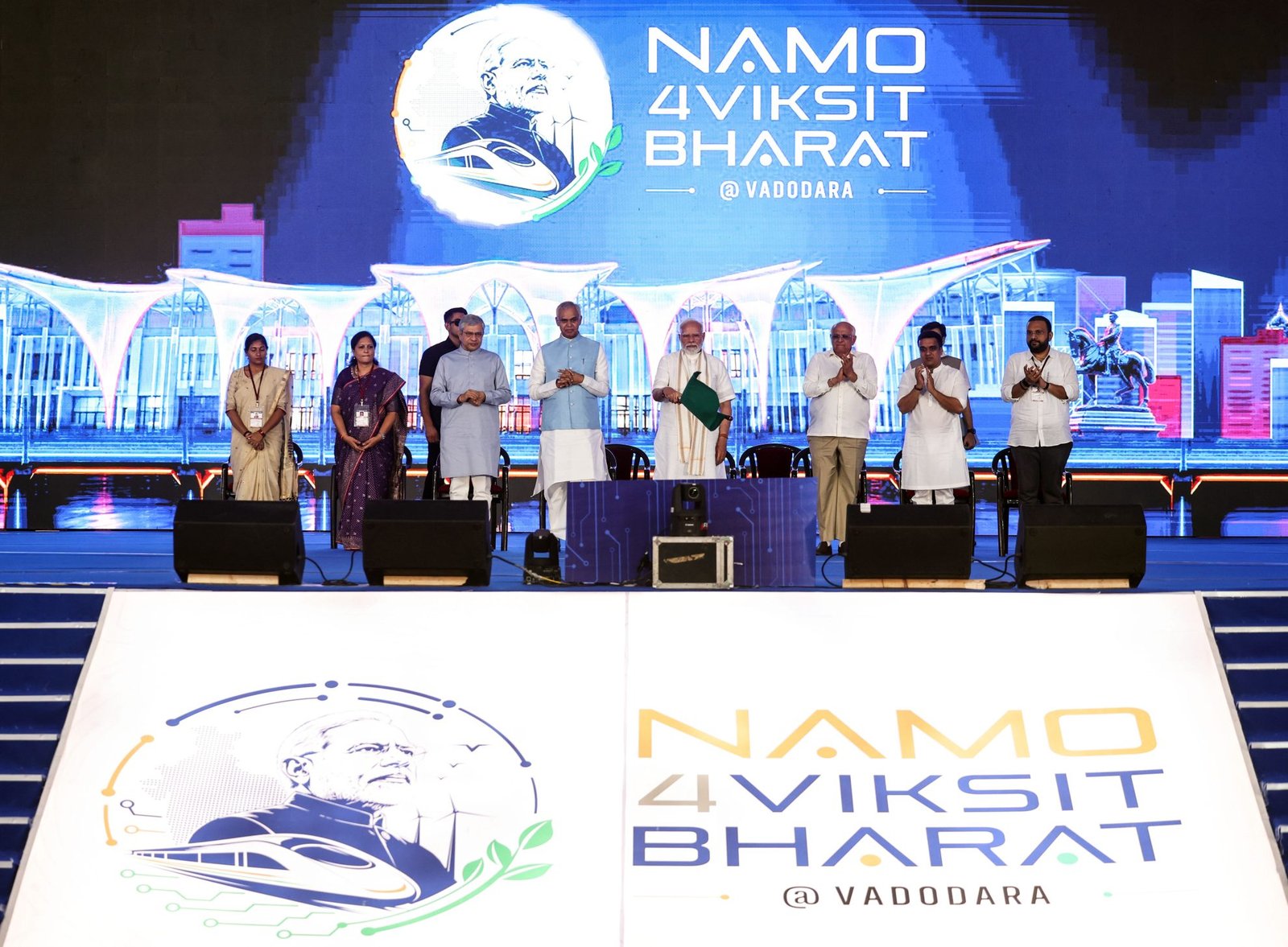
Vadodara, September 8: Prime Minister Narendra Modi on Tuesday inaugurated, dedicated to the nation and laid foundation stones for development projects worth more than ₹35,000 crore in Vadodara, Gujarat, underlining the role of modern infrastructure in India’s journey towards becoming a developed nation by 2047.
Addressing the ‘NaMo for Viksit Bharat’ event at the Maharaja Sayajirao University ground, PM Modi described the completion of the 2,800-kilometre Eastern and Western Dedicated Freight Corridors as a major milestone in India’s infrastructure development.
He said the separation of freight and passenger traffic had helped improve railway efficiency, with more than 430 freight trains operating daily on the two corridors.
Dedicated Freight Corridors Set to Transform Cargo Movement
Highlighting the impact of the Dedicated Freight Corridors, PM Modi said freight movement between major parts of the country had become significantly faster.
According to the Prime Minister, a journey that earlier took around 30 hours by truck can now be completed in approximately 10 to 12 hours through the Dedicated Freight Corridor network.
The faster movement of goods is also expected to benefit farmers and agricultural producers by helping perishable commodities such as flowers, fruits and vegetables reach markets and mandis more quickly.
The Prime Minister said the freight corridors were emerging as a new lifeline for India’s transportation and commercial networks by improving connectivity between production centres, markets and ports.
Double-Stack Trains Boost Freight Capacity
PM Modi also highlighted the operation of double-stack container freight trains between Jawaharlal Nehru Port in Mumbai and Vadodara.
He said a single double-stack freight train could carry cargo equivalent to more than 250 trucks, illustrating the increased capacity and efficiency being brought into India’s freight transportation system.
The expansion of dedicated freight infrastructure is expected to support faster movement of large volumes of goods across the country while reducing pressure on conventional railway routes.
Railway Connectivity Reaches Remote and Tribal Areas
The Prime Minister also pointed to the expansion of railway connectivity into remote and tribal regions of Gujarat, Madhya Pradesh and Maharashtra.
He said areas that had remained without adequate rail connectivity for decades were increasingly being brought onto the railway network.
The expansion is aimed not only at improving passenger mobility but also at connecting communities with markets, education, employment opportunities and other economic centres.
Infrastructure Investment and Employment
Linking infrastructure development with job creation, PM Modi said investments in railways, roads, ports, airports and other infrastructure generate economic activity around them.
He highlighted the railway budget of more than ₹2.75 lakh crore, describing railway modernisation as an important part of the country’s wider infrastructure expansion.
The Prime Minister also spoke about India’s growing manufacturing capabilities, particularly in Vadodara.
He highlighted the city’s emergence as a manufacturing location for India’s first domestically produced C-295 military transport aircraft, while also pointing to the expansion of railway manufacturing since 2014.
According to the Prime Minister, India has produced around 50,000 modern railway coaches and added nearly 2.5 lakh wagons to the railway network during this period.
Clean Energy Gets Greater Push
PM Modi also highlighted India’s efforts to expand renewable energy and domestic solar manufacturing capacity.
Referring to the floating solar project at Kadana Dam and the PM Surya Ghar Muft Bijli Yojana, he said around 55 lakh families across India, including 11 lakh in Gujarat, had become electricity producers through the rooftop solar initiative.
The Prime Minister said a stronger power ecosystem would become increasingly important as emerging sectors such as data centres and artificial intelligence expand.
He also underlined the need to strengthen access to strategic resources, including uranium, critical minerals and rare earth elements, to support India’s future industrial and technological requirements.
Focus on Skills and Future Employment
The Prime Minister stressed that conventional degrees alone may not be sufficient in an economy undergoing rapid technological and industrial changes.
He called for continuous skill development so that young people can adapt to changing employment requirements.
PM Modi also announced a move towards providing free coaching for competitive examinations, saying the initiative would help reduce the financial burden on poor and middle-class families.
“The government itself will take care of the coaching of our youth,” he said.
National AI Skills Campaign Planned
Artificial intelligence also featured prominently in the Prime Minister’s address.
PM Modi announced plans for a national campaign to equip young people with AI skills, with applications expected across sectors such as agriculture, healthcare, robotics, manufacturing and start-ups.
The initiative reflects the government’s broader emphasis on developing a workforce capable of participating in technology-driven industries.
The Prime Minister said India’s future growth would depend on combining infrastructure development with manufacturing, clean energy, technological capabilities and skilled human resources.
The projects unveiled in Vadodara, he said, are part of this larger development vision, with infrastructure being positioned as a key driver of India’s economic expansion and its goal of becoming a developed nation by 2047.