


















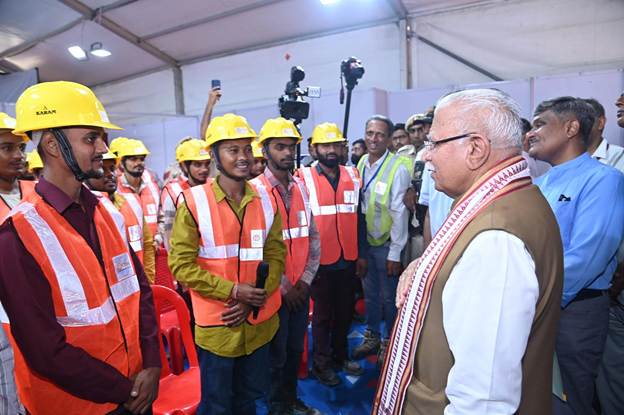
JUNE 26: Union Minister for Housing and Urban Affairs and Power, Shri Manohar Lal, awarded skill certification to 40 trained workers at a Labour Skill Certification Ceremony organized by the Central Public Works Department (CPWD) on June 26, 2025. The event, held at the GPRA (General Pool Residential Accommodation) project site in Kasturba Nagar, New Delhi, was conducted under the Government of India’s Skill India Mission.
The 40 workers received their certificates after completing an 80-hour onsite training in MIVAN Shuttering Systems, a modern construction technique. This initiative is part of CPWD’s wider goal to provide practical skill development opportunities directly at construction sites, aiming to bridge the skill gap in the infrastructure sector.
Shri Manohar Lal emphasized the growing importance of skilled labour in boosting the efficiency and quality of public infrastructure. He noted that such initiatives are vital for realising the national vision of Viksit Bharat 2047, where development is inclusive, sustainable, and efficient. The Minister praised CPWD’s grassroots-level approach to training and its alignment with the National Skill Development Mission.
Highlighting future goals, Shri Manohar Lal announced that CPWD will scale up its efforts by training around 35,000 workers over the current and next financial year—10,000 this year and 25,000 the next. Furthermore, he declared a new mandate for large-scale projects: contractors working on projects above ₹10,000 crore must engage at least 20% certified skilled labour or ensure formal onsite training.
The training programme, conducted in partnership with the National Real Estate Development Council (NAREDCO), certified workers as Assistant Shuttering Carpenters (Aluminium Shuttering). This follows a similar Phase-I effort where 40 workers were certified as Assistant Masons.
The GPRA redevelopment project, where the training was held, involves modern G+13 towers with over 2,000 flats, employing cutting-edge construction techniques like monolithic concrete and aluminium formwork. The project also aims to achieve a GRIHA 4-Star Rating by integrating sustainable practices, such as the use of fly ash, solar panels, energy-efficient equipment, and eco-friendly construction materials.
This initiative reflects the government’s commitment to building a highly skilled workforce while championing innovation and sustainability in India’s public infrastructure landscape.