















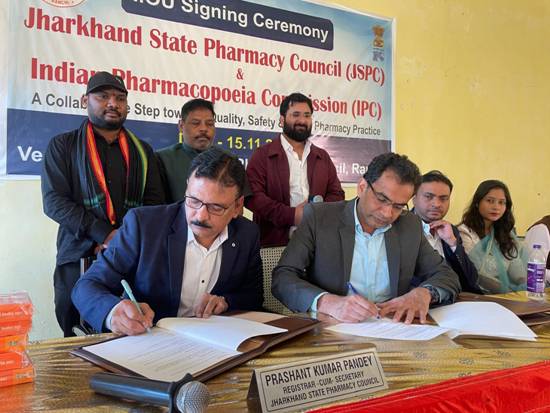
NOV 15:The Indian Pharmacopoeia Commission (IPC), Ghaziabad—an autonomous institution functioning under the Ministry of Health and Family Welfare—has entered into a significant Memorandum of Understanding (MoU) with the Jharkhand State Pharmacy Council (JSPC). The agreement marks an important step toward strengthening the safe and rational use of medicines, enhancing pharmacovigilance and materiovigilance activities, and reinforcing patient safety frameworks across Jharkhand.
The MoU was formally signed by Dr. V. Kalaiselvan, Secretary-cum-Scientific Director of IPC, and Shri Prasanth Kumar Pandey, Registrar-cum-Secretary of JSPC, in the presence of officials from both organisations. This partnership aims to upgrade the professional competencies of registered pharmacists by equipping them with the skills required for adverse drug reaction (ADR) reporting, monitoring medicine safety, and adopting evidence-based pharmacy practices.
One of the major focus areas of the collaboration is to promote the wider adoption of the National Formulary of India (NFI) as a standard reference document across healthcare facilities in the state. By encouraging the routine use of NFI, the initiative seeks to improve rational dispensing, strengthen medication counseling, and support safe and effective therapeutic decisions by pharmacists.
Under the MoU, IPC and JSPC will coordinate to organise awareness programmes, workshops, and capacity-building activities for hospital and community pharmacists. Efforts will also be made to ensure the mandatory use of the NFI in institutional pharmacy settings and to facilitate the annual observance of National Pharmacovigilance Week with active participation from healthcare professionals across Jharkhand.
While IPC will provide technical expertise and guidance, JSPC will play a critical role in liaising with pharmacists in both government and private healthcare institutions to implement the initiatives effectively. The collaboration reflects a shared commitment to advancing public health by improving medication safety, promoting responsible medicine use, and strengthening surveillance systems for better patient outcomes.


, Ghaziabad—an autonomous institution functioning under the Ministry of Health and Family Welfare has)