




















Editor-in-Chief
Sahil Aggarwal
March 8, 2026
Artificial Intelligence (AI) has emerged as one of the most transformative technologies of the twenty-first century. From powering search engines and medical diagnostics to supporting financial systems and smart devices, AI now influences nearly every aspect of daily life. While its potential to improve efficiency and innovation is immense, AI also raises serious ethical concerns.
Issues such as algorithmic bias, data privacy risks, lack of transparency, and the social impact of automated decision-making have triggered global discussions about responsible technology development. In this evolving landscape, women leaders are playing a crucial role in promoting ethical and accountable artificial intelligence.
What Ethical Artificial Intelligence Means
Ethical Artificial Intelligence refers to designing and deploying AI systems that respect human values, fairness and accountability. Unlike conventional software, AI systems learn patterns from large datasets. If the training data reflects social inequalities or historical bias, algorithms may unintentionally replicate or even amplify those disparities.
For instance, biased datasets can influence hiring software, credit approval systems and facial recognition tools in ways that disadvantage certain communities. Such outcomes highlight why ethical safeguards are essential.
Ethical AI is built on several core principles:
-
Fairness – preventing discrimination and bias
-
Transparency – ensuring decisions made by AI systems can be understood
-
Privacy Protection – safeguarding personal data
-
Accountability – establishing responsibility for automated decisions
-
Human Oversight – keeping human judgment central to critical processes
Importantly, ethical AI extends beyond technical fixes. It requires collaboration between technologists, social scientists, policymakers and ethicists to evaluate how automated systems affect society.
The Importance of Diverse Leadership in AI
The technology sector has historically struggled with gender diversity, especially in advanced fields like artificial intelligence and machine learning. Limited representation can lead to narrow perspectives during system design, increasing the risk of overlooking social consequences.
Women leaders are helping bridge this gap by bringing interdisciplinary expertise and human-centered perspectives to AI innovation. Many women working in AI ethics combine knowledge of computer science with sociology, law, philosophy and public policy. This allows them to better understand how algorithms interact with real-world social structures.
Their leadership is reshaping the AI conversation. Discussions are gradually shifting from technical performance metrics to broader concerns about justice, equality, human rights and social responsibility.
Influential Women Shaping Ethical AI
Several prominent women researchers and policy experts have significantly influenced the global push for responsible AI development.
Joy Buolamwini, a computer scientist and digital rights advocate, is widely known for exposing bias in facial recognition systems. Her research revealed that many AI models performed poorly when identifying women and individuals with darker skin tones. Her work encouraged governments and technology firms to re-evaluate algorithmic fairness.
Timnit Gebru, a leading researcher in ethical AI, has studied the societal risks of large-scale machine learning systems. She has consistently emphasized transparency, accountability and responsible data practices in AI development.

Rumman Chowdhury has contributed to practical tools that help organizations audit AI systems for bias and ethical risks. Her work enables companies to move from theoretical ethical commitments to real-world implementation.
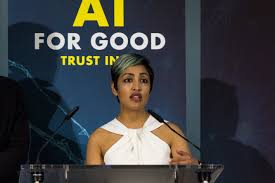
Legal scholar Sandra Wachter studies how legal systems can address challenges posed by automated decision-making. Her research explores algorithmic transparency and the “right to explanation,” ensuring individuals understand how automated decisions affect them.

Similarly, Aimee Van Wynsberghe focuses on moral responsibility in AI and robotics design. Her work promotes sustainable, human-centered technology development that prioritizes long-term societal well-being.

Women Influencing AI Policy and Governance
Ethical AI is not confined to research labs. Governments and international institutions are developing regulatory frameworks to guide AI innovation. Women leaders are actively contributing to these policy discussions.
Policy experts and advisors are helping design global frameworks based on fairness, accountability, transparency and respect for human rights. Their involvement ensures that ethical considerations remain central to technology governance.
Women also lead several international organizations focused on responsible innovation. These initiatives develop corporate guidelines, advise governments on regulation and educate communities about the societal impacts of AI technologies.
Challenges in Building Ethical AI
Despite growing awareness, major challenges remain in implementing ethical AI practices.
Rapid Technological Change: AI evolves faster than regulatory systems, making it difficult for laws to keep pace with innovation.
Limited Representation: A lack of diversity in AI development teams makes it harder to identify potential social harms.
Global Coordination: AI systems operate across borders, requiring international cooperation for consistent ethical standards.
Women leaders frequently stress that inclusive participation is essential to identify risks and design equitable technological systems.
The Path Forward
The future of artificial intelligence depends not only on technological progress but also on ethical leadership. Encouraging more women to enter fields such as computer science, data science and technology policy will strengthen the diversity of perspectives guiding AI innovation.
Educational institutions, governments and private organizations must support inclusive innovation through:
-
Mentorship programs
-
Equitable hiring practices
-
Research funding opportunities
-
Leadership development initiatives
Equally important is integrating ethics into technical education. Future engineers and developers must be trained to consider social consequences alongside technical efficiency.
Conclusion
Artificial Intelligence is reshaping modern society, offering tools that can transform healthcare, education, transportation and governance. However, it also presents complex ethical challenges that require thoughtful oversight.
Women leaders across research, policy and technology sectors are making powerful contributions toward responsible AI development. By promoting fairness, transparency, accountability and human-centered design, they are ensuring that innovation benefits society as a whole.
As AI continues to evolve, inclusive leadership will remain vital. The growing influence of women in AI ethics demonstrates that sustainable technological progress is strongest when diverse voices guide the future.