



















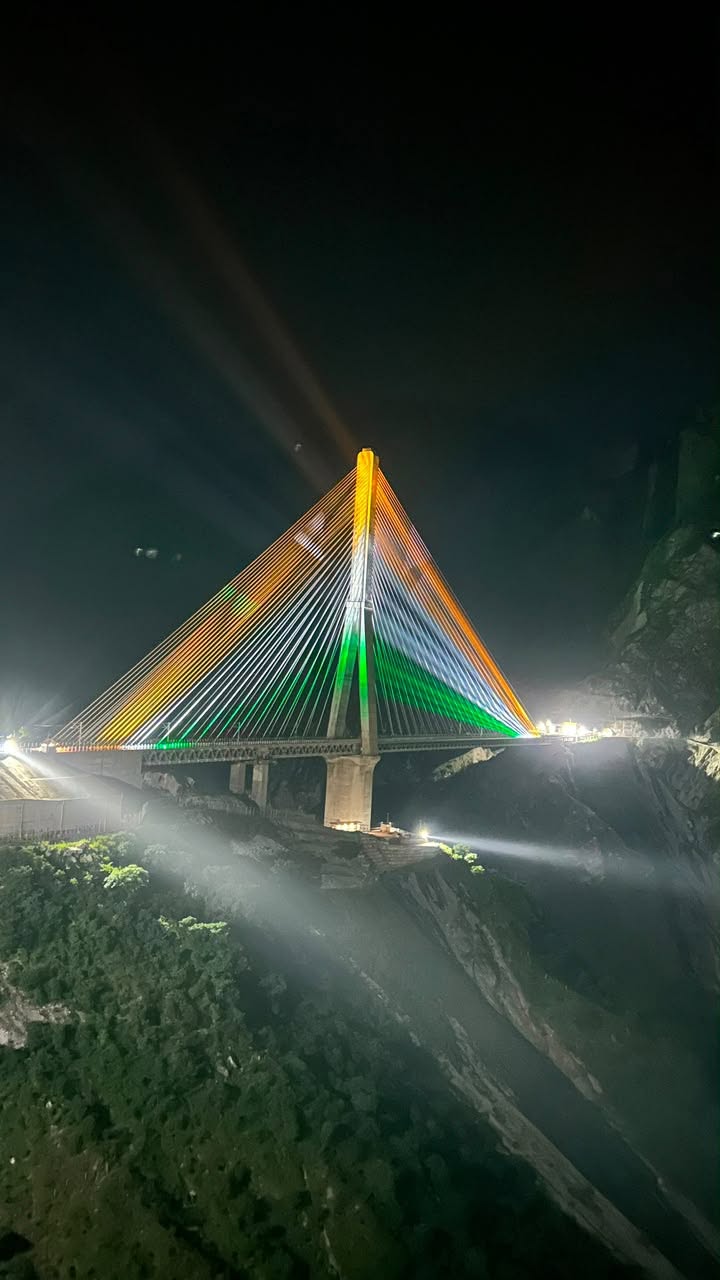
Jammu & Kashmir, August 15, 2026: The spirit of Independence Day was reflected across Jammu & Kashmir as the national Tricolour illuminated two of the region’s most remarkable railway structures — the Chenab Rail Bridge and the Anji Khad Bridge.
The iconic structures, built across the challenging Himalayan terrain, have emerged as powerful symbols of India’s engineering capabilities and the transformation of rail connectivity in Jammu & Kashmir.
Chenab Rail Bridge: A Landmark of Indian Engineering
Standing tall over the Chenab River, the Chenab Rail Bridge has gained international recognition as the world’s highest railway arch bridge. Its massive steel arch rises above the river and represents one of the most challenging railway infrastructure projects undertaken in the region.
The bridge forms an important part of the Udhampur-Srinagar-Baramulla Rail Link (USBRL) project, which is aimed at providing an all-weather railway connection to the Kashmir Valley.
Beyond its engineering significance, the bridge has become a symbol of connectivity, development and national pride.
Anji Khad Bridge Adds Another Engineering First
The Anji Khad Bridge, another key component of the USBRL project, represents a different approach to railway engineering.
It is recognised as India’s first cable-stayed railway bridge, featuring a distinctive cable-supported design constructed across the difficult Himalayan landscape.
The bridge has been designed to overcome complex geological and geographical challenges while enabling railway connectivity through one of the country’s most demanding terrains.
Symbols of a New Era of Connectivity
Together, the Chenab and Anji Khad bridges represent more than spectacular engineering achievements. They are part of a larger infrastructure effort aimed at improving connectivity between Jammu and Kashmir and the rest of the country.
The bridges demonstrate how modern engineering solutions are being adapted to challenging mountain conditions while creating infrastructure that can support economic development, tourism and easier movement of people.
Their presence beneath the national flag on Independence Day therefore carries a significance beyond architecture and construction. The Tricolour represents the aspirations of a nation, while these structures reflect the technological capability and determination involved in turning ambitious connectivity projects into reality.
Independence Day Adds to the Significance
The sight of the Tricolour over these engineering landmarks carries particular symbolism on Independence Day. The structures stand as examples of India’s progress in infrastructure development and its ability to undertake complex projects in difficult environments.
For Jammu & Kashmir, improved rail connectivity has the potential to bring significant benefits to residents, businesses and visitors while strengthening links between different parts of the Union Territory and the country.
As India celebrates Independence Day, the Chenab Rail Bridge and Anji Khad Bridge offer a striking reminder of how engineering, infrastructure and national ambition can come together to create landmarks that define a new chapter in Jammu & Kashmir’s connectivity story.