













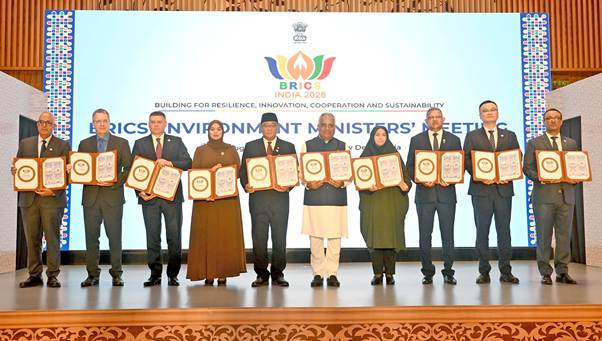
New Delhi, August 18, 2026: India’s BRICS 2026 Chairship has taken another step towards strengthening international cooperation on environmental sustainability with the launch of four collaborative knowledge compendiums at the 12th BRICS Environment Ministers’ Meeting.
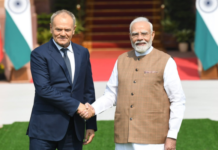
Union Minister for Environment, Forest and Climate Change Bhupender Yadav, along with heads of delegations from BRICS member countries, unveiled the knowledge products prepared through the BRICS Environment Working Group. The compendiums bring together national experiences, innovative approaches, policy practices and local knowledge from participating countries.
The initiative highlights the growing importance of collective action on issues such as sustainable lifestyles, wildfire management, ecosystem restoration and the transition towards a circular economy.
Four Knowledge Products Focused on Key Environmental Challenges
The first compendium focuses on sustainable lifestyles, bringing together successful initiatives and experiences from BRICS nations. It covers areas including environmental education, behavioural change, sustainable consumption, circular economy practices, ecosystem restoration and clean energy.
India’s contributions include initiatives such as Mission LiFE, the Environment Education Programme and the SAMBHAV Campaign. The document highlights how individual choices, government policies and market changes can collectively contribute to more sustainable development.
The second knowledge product deals with integrated wildfire management. With changing climate conditions, prolonged dry periods and rising temperatures increasing wildfire risks in many parts of the world, the compendium brings together approaches related to prevention, preparedness, early-warning systems and coordinated response.
It also highlights the importance of combining modern technology with community participation and indigenous knowledge to protect forests, biodiversity and livelihoods.
The third compendium addresses integrated landscape-based greening approaches. It examines ways to tackle interconnected challenges such as land degradation, desertification, biodiversity loss and climate change through ecosystem restoration and landscape-level planning.
The document also identifies opportunities for greater BRICS cooperation through knowledge exchange, technical assistance, capacity building and collaborative research.
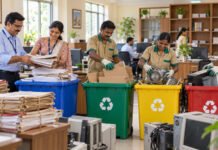
The fourth compendium focuses on Extended Producer Responsibility (EPR) and circular economy practices. It presents policy and regulatory approaches adopted by BRICS countries to promote resource efficiency, recycling and responsible waste management.
India’s experience with a market-based EPR system supported by digital platforms and expanded frameworks for different waste streams is among the practices highlighted in the document.
India Pushes for Practical Environmental Cooperation
The launch of these knowledge products comes as India seeks to use its BRICS Chairship to promote environmental cooperation that is practical, inclusive and focused on implementation.
Rather than serving only as repositories of information, the four compendiums are intended to support peer learning, joint research, technical cooperation and the adoption of successful environmental practices across BRICS nations.
The initiative also underlines the importance of combining government action with participation from communities, businesses and citizens. Areas such as sustainable consumption, forest protection, waste management and ecosystem restoration require long-term cooperation beyond national boundaries.
Towards a More Sustainable Future
The four compendiums collectively demonstrate how BRICS countries can share experiences and develop solutions to common environmental challenges. From encouraging sustainable lifestyles and preparing for wildfires to restoring landscapes and advancing circular economy models, the knowledge products cover several critical areas of environmental policy.
With India holding the BRICS Chairship in 2026, the initiative further strengthens the country’s role in encouraging dialogue and cooperation on global environmental priorities. The emphasis on sharing practical solutions could help BRICS nations develop approaches suited to their individual circumstances while learning from one another.
The launch therefore represents more than the release of four documents. It reflects an effort to turn shared environmental knowledge into collective action, with sustainability, resilience and responsible resource use at the centre of future cooperation.
Source: Press Information Bureau, Ministry of Environment, Forest and Climate Change, Government of India.