


















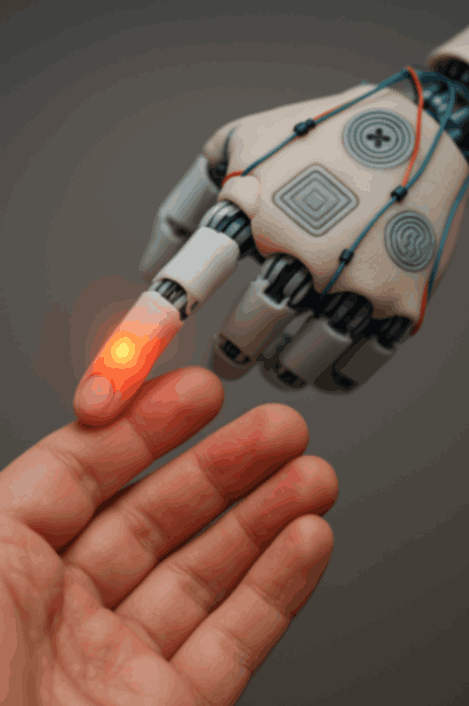
June 21: In a remarkable leap forward in soft robotics and artificial intelligence, researchers from the University of Cambridge and University College London have unveiled a revolutionary gel-based electronic skin that can sense heat, pain, pressure, and even multiple simultaneous touch points. What sets this innovation apart is its simplicity—engineered using a single piece of smart hydrogel embedded with ultra-fine conductive pathways, the skin eliminates the need for complex arrays of individual sensors traditionally required in electronic skins.
This soft, transparent material acts as a ‘digital nervous system’ and responds in real-time to external stimuli such as heat exposure, sharp pokes, and touch, closely mimicking the sensation capabilities of human skin. Over 860,000 tiny conductive lines within the gel continuously feed data to an AI model that interprets these sensations with remarkable accuracy. Whether pressed gently, poked sharply, or exposed to rising temperatures, the smart skin can immediately detect and categorize the stimulus.
The skin is fabricated at room temperature using a low-cost, non-toxic process that does not require harsh chemicals or high-end machinery. The result is a wearable, mouldable material that can be shaped into gloves or sleeves for robots and prosthetics—making it scalable for future industrial or medical applications.
One of the most significant breakthroughs lies in its multi-sensing ability from a single sheet of material. Instead of dedicating separate hardware for heat, pressure, and pain, the gel’s internal structure, combined with machine learning algorithms, decodes a wide spectrum of sensations simultaneously, akin to how human nerves interpret complex stimuli through a singular biological network.
Published in the journal Science Robotics, this cutting-edge development has profound implications. From robotic arms in healthcare and caregiving to high-precision industrial automation and even prosthetic limbs capable of sensory feedback, this skin could redefine how machines interact with their surroundings—and with people.
The team is now working on increasing the durability of the material and exploring its deployment in prosthetic systems, emergency robotics, and wearable health monitors. As the line between biology and robotics continues to blur, innovations like this bring us closer to a future where artificial intelligence doesn’t just compute—it feels.