


















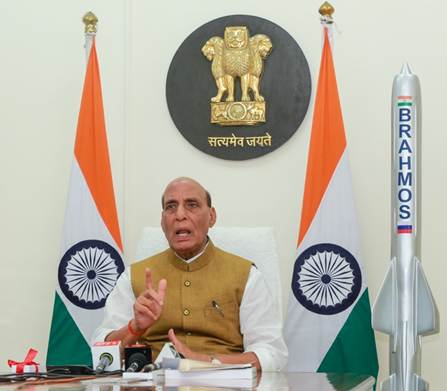
Dec 29: In a significant move to enhance India’s military preparedness and technological edge, the Defence Acquisition Council (DAC), chaired by Raksha Mantri Shri Rajnath Singh, has accorded Acceptance of Necessity (AoN) to defence procurement proposals worth approximately ₹79,000 crore. The approvals were granted during the DAC meeting held on December 29, 2025, covering critical capability upgrades for the Indian Army, Navy and Air Force.
The clearance reflects the Government of India’s continued focus on strengthening national security through modern, high-technology platforms while ensuring operational readiness across all three services.
Army to Gain Precision Strike and Drone Defence Capabilities
For the Indian Army, the DAC approved proposals for the procurement of several advanced systems aimed at improving battlefield effectiveness and protection. These include Loiter Munition Systems for artillery regiments, Low Level Light Weight Radars, Long Range Guided Rocket Ammunition for the Pinaka Multiple Launch Rocket System (MRLS), and the Integrated Drone Detection & Interdiction System Mk-II.
Loiter munitions will provide the Army with enhanced precision strike capability against tactical targets, while the lightweight radars will improve detection and tracking of small, low-flying unmanned aerial systems. The long-range guided rockets will significantly increase the range and accuracy of Pinaka MRLS, enabling effective engagement of high-value targets. The upgraded drone detection and interdiction system will help protect vital assets in both tactical battle areas and hinterland locations.
Navy Strengthened with ISR and Communication Upgrades
The DAC also cleared key proposals for the Indian Navy, focusing on operational support, surveillance and secure communications. These include procurement of Bollard Pull (BP) Tugs, High Frequency Software Defined Radios (HF SDR) Manpack, and leasing of High Altitude Long Range (HALE) Remotely Piloted Aircraft Systems (RPAS).
The induction of BP Tugs will improve maneuverability of naval ships and submarines during berthing and unberthing operations in confined harbour areas. The HF SDR systems will enhance long-range, secure communication during critical boarding and landing missions. Meanwhile, HALE RPAS will provide continuous Intelligence, Surveillance and Reconnaissance (ISR) capabilities, strengthening maritime domain awareness across the Indian Ocean Region.
Air Force Gets Boost in Safety, Training and Strike Power
For the Indian Air Force (IAF), the DAC approved procurement of Automatic Take-off Landing Recording Systems, Astra Mk-II air-to-air missiles, Full Mission Simulators for LCA Tejas, and SPICE-1000 long-range guidance kits.
The automatic recording systems will enhance aerospace safety by providing high-definition, all-weather recording of take-offs and landings. Astra Mk-II missiles, with extended range, will significantly improve the IAF’s ability to neutralise adversary aircraft from stand-off distances. The Tejas full mission simulators will strengthen pilot training in a safe and cost-effective manner, while SPICE-1000 kits will boost long-range precision strike capabilities.
Strategic Signal of Self-Reliance and Readiness
The ₹79,000 crore AoN approvals underline India’s commitment to defence modernisation, self-reliance and operational superiority. By focusing on advanced weapon systems, surveillance platforms and training infrastructure, the government continues to reinforce the Armed Forces’ ability to respond to evolving security challenges.
These decisions also align with the broader vision of Aatmanirbhar Bharat in defence, ensuring that India remains prepared, resilient and technologically advanced in safeguarding its national interests.


)