


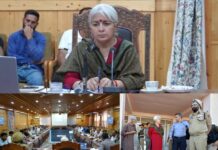








DEC 27 : In a significant step towards improving urban mobility and road safety, the Divisional Commissioner Kashmir chaired a meeting of the Multi-Disciplinary Committee on Traffic Management to review and approve a series of key proposals aimed at streamlining traffic movement in Srinagar city. The meeting focused on adopting both infrastructural and technology-driven solutions to address congestion, enhance commuter convenience and ensure safer roads.
During the deliberations, the committee examined proposals related to the construction of rotaries at critical junctions to regulate traffic flow and reduce bottlenecks. Road widening plans at identified stretches were also reviewed, with an emphasis on easing congestion in high-density areas and improving connectivity across the city.
The introduction of one-way traffic systems on select roads formed an important part of the discussion. Officials highlighted that scientifically planned one-way corridors can significantly reduce traffic snarls, improve average travel speed and enhance pedestrian safety. Alongside this, the committee discussed the identification and notification of no-honking zones, particularly around hospitals, educational institutions and residential areas, to reduce noise pollution and improve the quality of urban life.
A major focus of the meeting was on the integration of technology into traffic management. Proposals for IT-based parking systems were reviewed to address the persistent problem of illegal and haphazard parking in Srinagar. The system aims to provide real-time information on parking availability, promote better utilisation of designated parking spaces and reduce congestion caused by vehicles searching for parking.
The committee also took stock of preparations for strengthening e-bus infrastructure in the city. Enhancing facilities for electric buses, including charging infrastructure and dedicated operational planning, was identified as a key component of promoting sustainable and environment-friendly public transport. The Divisional Commissioner emphasised that encouraging the use of public transport is essential for reducing private vehicle dependence and lowering traffic congestion.
Another critical aspect discussed was the expedited installation of Intelligent Traffic Management System (ITMS) cameras across Srinagar. These cameras are expected to play a vital role in monitoring traffic violations, managing traffic signals efficiently and improving enforcement through data-driven interventions. Officials were directed to fast-track the implementation process to ensure timely operationalisation of the system.
The Divisional Commissioner stressed the importance of inter-departmental coordination for effective execution of the approved proposals. He underlined that traffic management is a shared responsibility and requires seamless collaboration among traffic police, urban development authorities, transport department and municipal bodies. He also emphasised the need for public awareness and cooperation to ensure the success of the initiatives.
Officials informed that the approved measures would be implemented in a phased manner, prioritising high-impact areas and traffic hotspots. Regular monitoring and review mechanisms will be put in place to assess outcomes and make necessary adjustments based on ground realities.
The meeting concluded with a clear roadmap for moving forward, reflecting the administration’s commitment to building a safer, more efficient and commuter-friendly traffic system in Srinagar. The proposed interventions are expected to not only improve traffic flow but also enhance overall urban mobility, reduce accidents and contribute to a more organised and sustainable city environment.
With these initiatives, Srinagar is set to take a decisive step towards modern, technology-enabled traffic management aligned with the needs of a growing urban population