


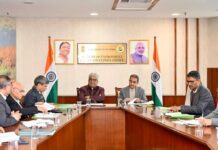














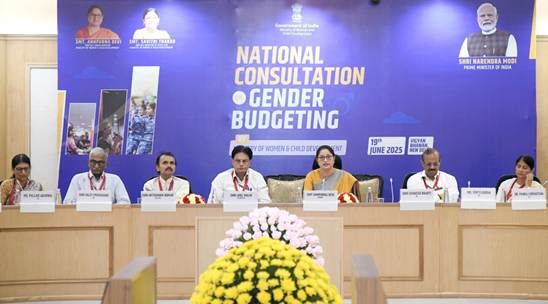
JUNE 19: In a significant step toward strengthening gender-responsive governance under the Viksit Bharat@2047 vision, the Ministry of Women and Child Development hosted a first-of-its-kind National Consultation on Gender Budgeting at Vigyan Bhawan, New Delhi, on 19th June 2025. The event saw participation from senior officials representing 40 central ministries and departments, 19 state governments, experts from national institutions, and global stakeholders including UN Women and the Asian Development Bank (ADB).
Union Minister Smt. Annpurna Devi inaugurated the consultation and launched the ‘Gender Budgeting Knowledge Hub’, a dedicated digital platform that will serve as a comprehensive repository of resources, data, and best practices for stakeholders across the country. The Hub is designed to facilitate better policy planning and implementation through knowledge sharing.
In her keynote address, Smt. Annpurna Devi emphasized that gender budgeting has evolved from a fiscal exercise into a powerful governance mechanism that aligns financial allocations with the goals of social equity, empowerment, and nation-building. “When we invest in women, we’re not just allocating resources—we’re investing in the future of a just, empowered, and developed India,” she remarked.
The Minister highlighted the dramatic growth in Gender Budget allocations, which have surged more than four-fold over the past decade—from ₹0.98 lakh crore in 2014–15 to ₹4.49 lakh crore in 2025–26, reflecting a 37% increase over the previous year.
The day-long consultation focused on assessing the journey of 20 years of Gender Budgeting in India, and deliberated on the Ministry’s Draft Training Manual—a key capacity-building document designed to guide ministries and departments in institutionalizing gender budgeting practices.
Several central and state representatives shared their initiatives, demonstrating how gender budgeting has helped mainstream gender equity across sectors including education, health, rural development, and social welfare.
The consultation concluded with a renewed commitment to embed gender perspectives into every layer of governance and financial planning, reinforcing that gender budgeting is not just a financial tool—but a national imperative for inclusive and equitable development.