

















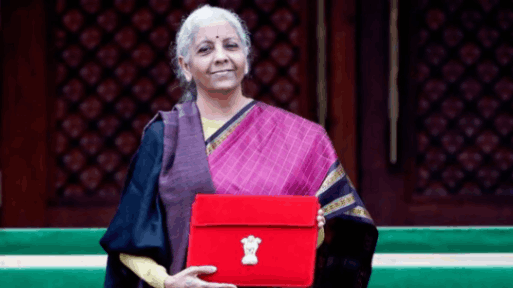
Feb 2: Finance Minister Nirmala Sitharaman presented the Union Budget 2026-27 on Saturday, outlining a comprehensive roadmap to strengthen manufacturing, infrastructure, and employment generation, while proposing a simpler and more predictable tax and customs regime. This marks her ninth consecutive Budget in Parliament.
Presenting the Budget amid global economic uncertainty, Ms Sitharaman detailed a multi-pronged growth strategy that includes expanding domestic electronics and semiconductor capacity, de-risking infrastructure projects, skilling youth for emerging technologies and easing compliance for taxpayers and importers.
Manufacturing Gets Major Boost
Manufacturing emerged as a key focus area in Budget 2026-27. The allocation for electronics components manufacturing was sharply increased to ₹40,000 crore, signalling a strong push to strengthen India’s position in global supply chains. New schemes for rare earth magnets, chemical parks, container manufacturing and capital goods aim to reduce import dependence and reinforce domestic capabilities.
The textile sector received an integrated, employment-oriented package covering fibres, industrial clusters, skilling and sustainability, reflecting the government’s focus on job-rich manufacturing.
Infrastructure and Urban Growth
Infrastructure spending received a further push with a higher capital expenditure (capex) allocation. Key initiatives include a risk guarantee fund to de-risk projects for private developers, the expansion of dedicated freight corridors, and the development of national waterways.
Tier-II and Tier-III cities have been placed at the heart of urban expansion through the creation of City Economic Regions, supported by reform-linked funding to drive balanced regional growth.
Fiscal Discipline Maintained
Reaffirming the government’s commitment to fiscal consolidation, the Finance Minister projected the fiscal deficit at 4.3% of GDP in 2026-27, lower than the 4.4% estimated for the current financial year.
Jobs, Skilling and Services Economy
The Budget placed renewed emphasis on the services sector as a major employment engine. A high-powered Education-to-Employment and Enterprise Committee will realign skilling programmes with market demand, including the impact of emerging technologies.
The creative economy received a boost through the establishment of AVGC labs in schools and colleges, support for animation, gaming and comics, and capacity building in design and hospitality. Tourism-linked skilling, including digital heritage documentation, highlights the intent to convert culture into jobs and exports.
AI as a Growth Enabler
Artificial Intelligence (AI) has been positioned as a cross-sector enabler. The Budget proposes AI-enabled advisory tools for farmers, integration of AI in education curricula and wider adoption across governance and skilling ecosystems.
Tax and Customs Reforms
A major structural reform comes with the Income Tax Act, 2025, effective from April 1, 2026, aimed at simplifying rules and redesigning forms. Compliance relief includes extended timelines for revising returns, staggered ITR due dates and easier filing of Form 15G/15H.
Customs duty rationalisation continued with exemptions for capital goods used in lithium-ion batteries, critical minerals processing, nuclear power projects and aircraft manufacturing. Personal imports will become cheaper with a reduction in duty from 20% to 10%, while 17 cancer drugs and rare-disease treatments have been exempted from customs duty.
Overall, Union Budget 2026-27 seeks to balance growth, fiscal discipline and ease of doing business, while laying the foundation for a resilient and future-ready Indian economy.