


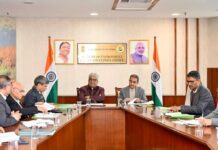







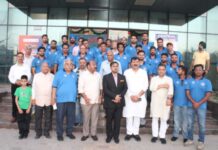




AUG 05:A high-level meeting of the Consultative Committee of Members of Parliament for the Ministry of Power was held on 4th August 2025, chaired by Union Minister for Power and Housing Affairs, Shri Manohar Lal. The focus of the meeting was on advancing Grid-Scale Energy Storage Systems (ESS) to strengthen India’s renewable energy capacity and ensure grid stability.
The meeting was attended by Minister of State for Power and New & Renewable Energy, Shri Shripad Yesso Naik, Members of Parliament, senior officials from the Ministry, Central Public Sector Undertakings (CPSUs), and experts from the Central Electricity Authority (CEA).
In his address, Shri Manohar Lal reiterated India’s climate goals — reducing the Emissions Intensity of GDP by 45% by 2030 (from 2005 levels) and achieving 50% of installed electricity capacity from non-fossil fuel sources by 2030. He highlighted the essential role of Energy Storage Systems in managing renewable energy variability, ensuring grid reliability, and enabling energy and peak shifting.
The Union Minister announced that under the Viability Gap Funding (VGF) scheme, 43 GWh of Battery Energy Storage Systems (BESS) would be developed with a financial outlay of ₹9,160 crore, making it one of the largest such initiatives globally. Additionally, ISTS charges have been waived for BESS projects commissioned by June 2028 and PSP projects awarded by the same date.
India has 6.4 GW of installed Pumped Storage Plant (PSP) capacity, with 8 GW under construction and 61 GW in various stages of planning. The CEA has launched a Single Window Clearance Cell to expedite PSP approvals.
Parliamentarians praised the VGF scheme and the growing role of smart meters and ESS in modernizing power distribution.
Concluding the session, the Minister of State noted that India has already achieved 50% installed capacity from non-fossil fuels, five years ahead of its 2030 target.